Blue Light, Brain Lock: How Mobile Screens Hijack Your Sleep, The Definitive Science-Backed Guide
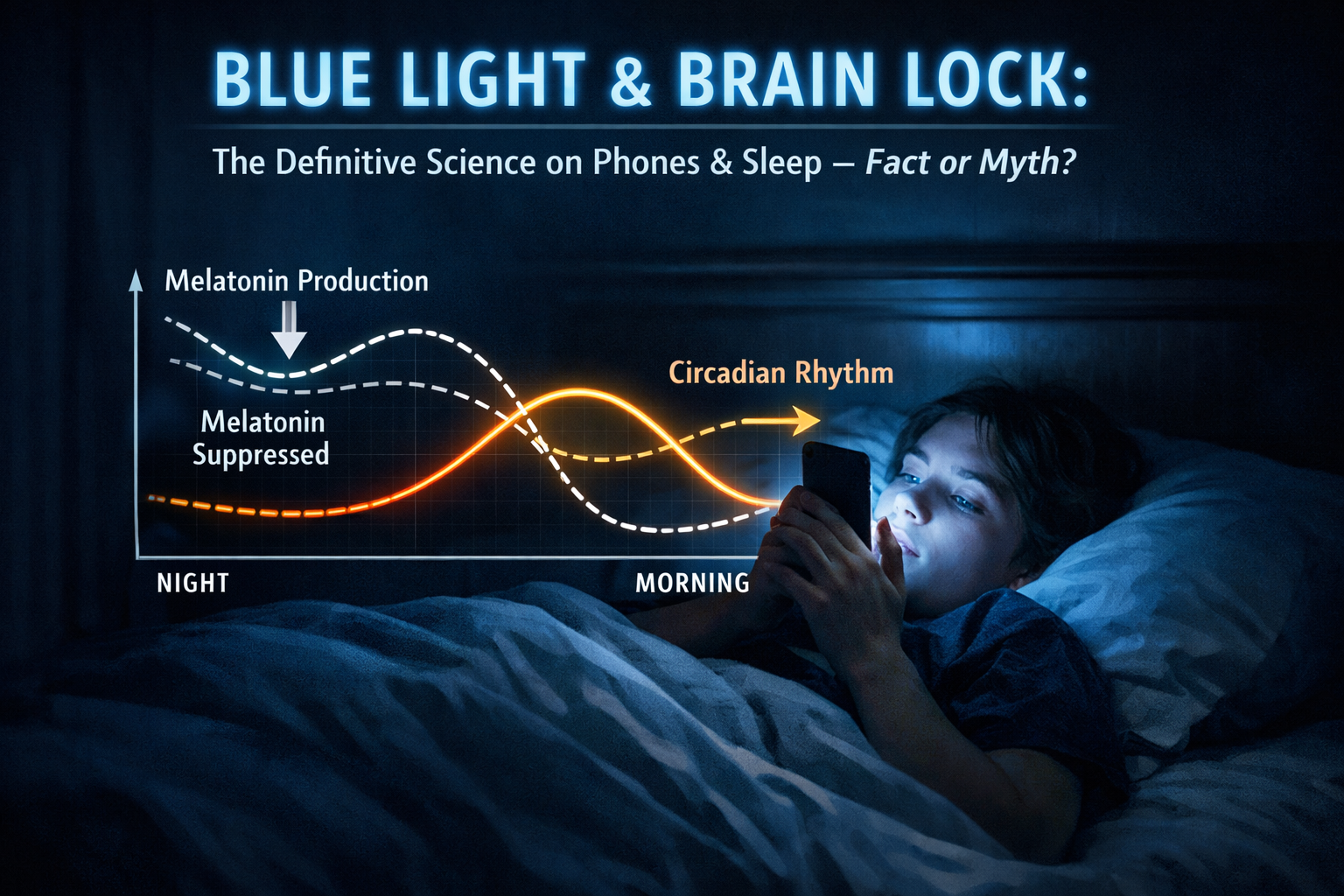
We’ve all heard the warning: “Don’t use your phone before bed it’ll ruin your sleep!” For every person who swears by blue light filters and strict digital curfews, there’s another who claims to sleep soundly after a late-night scroll.
So, where’s the truth? Is the connection between mobile screens and sleep disruption a scientific fact, a modern myth, or a nuanced reality? Let’s move beyond the headlines and into the peer-reviewed research to separate the signal from the noise.
The Core Mechanism: It’s Not Just “Light,” It’s a Biological Signal
The accusation against phones centers on short-wavelength blue light (approximately 460-480 nm). To understand why this specific light is problematic, we must understand our internal clock: the suprachiasmatic nucleus (SCN).
Your SCN uses environmental light cues, perceived through specialized cells in your eyes called intrinsically photosensitive retinal ganglion cells (ipRGCs), to regulate the production of melatonin, the “hormone of darkness” that primes your body for sleep.
Here’s what the research definitively shows happens when you look at a screen at night:
1. Melatonin Suppression: The Proven, Direct Effect
Multiple studies confirm that evening exposure to the blue-enriched light of self-luminous displays (like LED screens) significantly suppresses melatonin secretion.
Key Study (Harvard Medical School): A seminal study compared the effects of 6.5 hours of exposure to blue light vs. green light of comparable brightness. The blue light suppressed melatonin for about twice as long and shifted circadian rhythms by twice as much (3 hours vs. 1.5 hours) (Lockley et al., J Clin Endocrinol Metab, 2006).
The Smartphone-Specific Research: A 2019 study in the journal Sleep explicitly tested reading on an iPad versus a printed book before bed. The iPad readers showed suppressed melatonin levels, took longer to fall asleep, and had reduced REM sleep. They also reported feeling less alert the following morning (Chang et al., Sleep, 2019).
Fact: The blue light from mobile screens does, unequivocally, suppress melatonin production and delay the circadian clock.
2. The Psychological Stimulation Factor: A Powerful Co-Conspirator
While the blue light effect is physiological, the content you consume is psychological and it’s arguably just as damaging.
Cognitive Arousal: Scrolling through work emails, engaging in heated social media debates, or watching an exciting show activates your brain’s stress and reward pathways. This increases the release of cortisol and dopamine, putting your mind into a state of alertness that is the polar opposite of the calm needed for sleep onset.
The “Fear of Missing Out” (FOMO) Loop: Social media platforms are designed to be endless and engaging. The infinite scroll and variable rewards create a state of hyper-arousal and anxiety that is profoundly antagonistic to sleep. Research in The Lancet Psychiatry has linked high social media use at night with poor sleep quality, independent of screen light (Scott et al., 2019).
Fact: The engaging, often stressful content on phones induces psychological arousal, making it harder to “wind down,” separate from any biological light effect.
Myth-Busting: Where Public Perception Diverges from Science
Myth 1: “Night Shift / Blue Light Filters Are a Complete Solution.”
The Science Says: Partial, but insufficient. A 2020 study from the University of Manchester published in Current Biology found that while warmer (yellow) screen colors reduced melatonin suppression compared to cooler (blue) light, the overall brightness (luminance) of the screen was a more significant factor in impacting the circadian clock. Dimming your screen is often more effective than just shifting its color. Furthermore, filters do nothing for psychological arousal.
Myth 2: “I’ve Built Up a Tolerance; It Doesn’t Affect Me.”
The Science Says: Unlikely. While individual sensitivity varies, the ipRGC pathway is a fundamental, non-conscious biological system. You may not feel more awake, but objective measures like melatonin levels, core body temperature, and next-morning cognitive performance tests often show impairment. A 2018 review in Physiological Reports concluded that chronic nighttime screen exposure leads to cumulative sleep debt and circadian misalignment, even if subjectively unnoticed (Tähkämö et al., 2018).
Myth 3: “E-ink or Reading Mode Solves Everything.”
The Science Says: A major improvement, but context matters. An e-ink display (like on a Kindle without a front light) emits no blue light and is far less disruptive. However, if you’re using a “reading mode” on a standard LED screen that simply turns it sepia, you still have the issues of screen brightness and psychological engagement from the device itself.
The Synthesis: It’s a “Yes, And…” Situation
The science leads us to a clear, multi-faceted conclusion:
Mobile screens disrupt sleep through a DUAL MECHANISM:
BIOLOGICAL (Fact): Blue light emission suppresses melatonin and delays your circadian rhythm.
PSYCHOLOGICAL (Fact): Engaging content increases cognitive and emotional arousal, inhibiting sleep readiness.
Calling it a “myth” ignores over two decades of robust chronobiological research. Dismissing the psychological component gives the blue light factor too much credit.
Your Evidence-Based Sleep Hygiene Protocol
Based on the aggregate research, here is your strategic defense:
The 60-Minute Digital Sunset: This is the single most effective rule. Stop all interactive screen use (phones, tablets, computers) at least 60 minutes before your target bedtime. This allows melatonin to rise and arousal to fall.
Dim & Warm, Then Dim More: In the evening, first enable Night Shift/Warm Filter, then manually reduce screen brightness to the absolute minimum you can comfortably use.
Curate Content After Dark: If you must use your phone, make it passive and dull: listen to a calm podcast or audiobook (with the screen off), or read on a dedicated e-ink device. Avoid social media, email, and video.
Embrace the Analog Buffer: Replace the pre-bed scroll with a tangible, low-light activity: reading a physical book, light stretching, or journaling. This severs the digital-arousal link.
Charge It Outside the Room: This removes temptation, eliminates disruptive notifications, and reinforces the bedroom as a sanctuary for sleep and intimacy only.
The Final Verdict
Fact, not myth. The ability of mobile screens through their specific light signature and their engaging content to alter, delay, and degrade human sleep is one of the most well-documented phenomena in modern health science.
Your phone is a powerful tool for connection and information. But as the sun sets, it becomes a potent biological and psychological disrupter. Protecting your sleep isn’t about fearing technology; it’s about respecting the ancient, light-sensitive biology that your modern habits are overriding. The science is in. Your sleep is worth the disconnect.
References:
Lockley, S. W., et al. (2006). “Short-wavelength sensitivity for the direct effects of light on alertness, vigilance, and the waking electroencephalogram in humans.” Journal of Clinical Endocrinology & Metabolism.
Chang, A. M., et al. (2019). “Evening use of light-emitting eReaders negatively affects sleep, circadian timing, and next-morning alertness.” Sleep.
Tähkämö, L., et al. (2018). “Systematic review of light exposure impact on human circadian rhythm.” Physiological Reports.
University of Manchester. (2020). “Colour vision: A way animals tell the time of year?” (Press Release on luminance vs. color in circadian rhythms). Current Biology.
Scott, H., et al. (2019). “Social media use and adolescent sleep patterns: cross-sectional findings from the UK Millennium Cohort Study.” The Lancet Psychiatry.

Comments
Please login to post a comment
LoginNo comments yet. Be the first to comment!