Requiem for a King: The Story of BlackBerry's Rise and Spectacular Fall

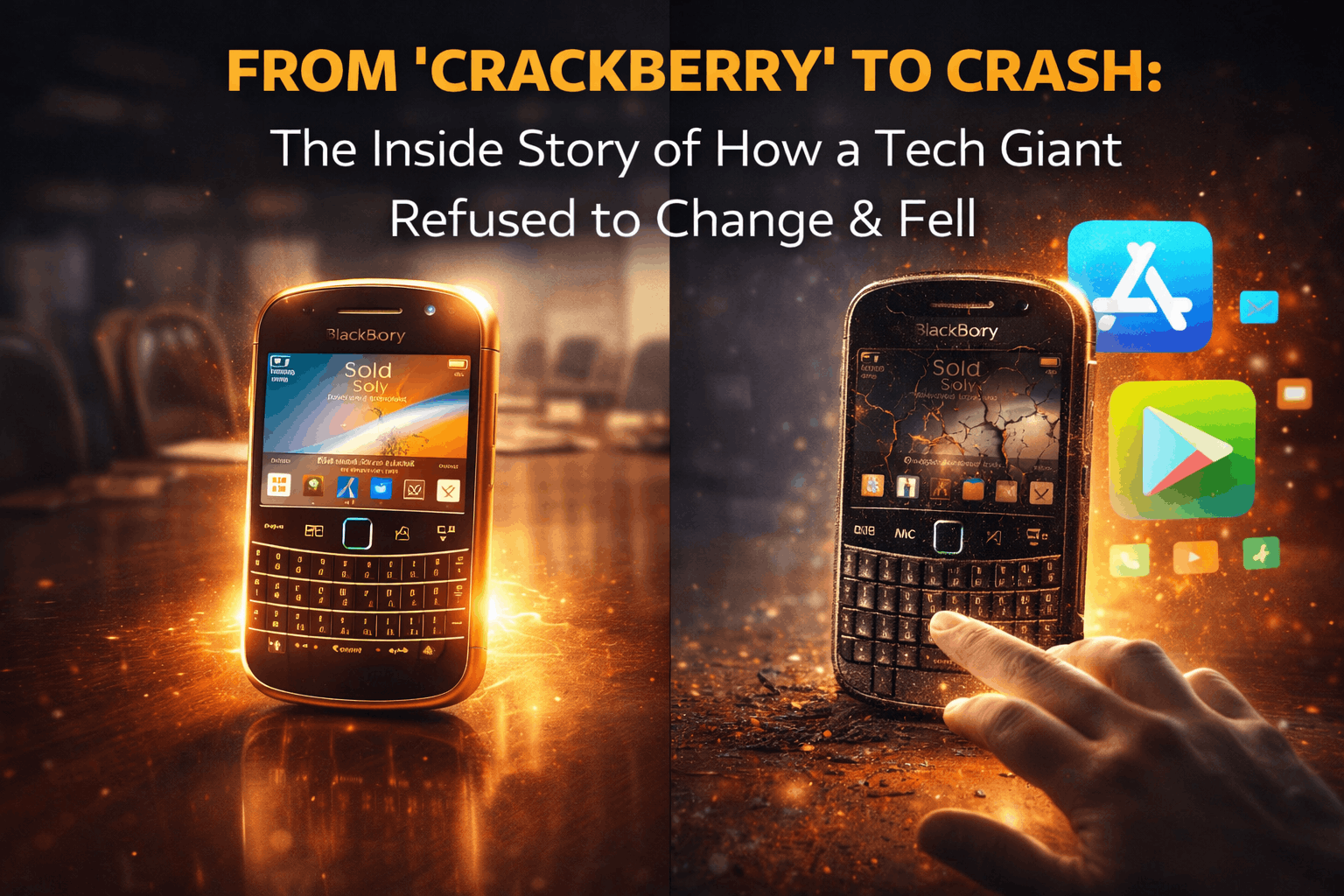
In the history of technology, few stories are as dramatic and cautionary as that of BlackBerry. It wasn't just a company; it was a status symbol, a culture, and an addiction. At its peak, it commanded 43% of the US smartphone market. Its devices were dubbed "CrackBerries" for their hold on users, and they were so essential to the global elite that President Obama fought to keep his after taking office. Yet, in a breathtakingly short span, this giant fell from grace, becoming a case study in catastrophic corporate myopia. This is the story of how BlackBerry saw the future, dismissed it, and was buried by it.
Act I: The Rise of the "CrackBerry" – Secure, Efficient, Essential
The seeds were planted in 1999 with the BlackBerry 850 a two-way pager with secure email. But the true revolution came with the BlackBerry 6210 in 2003, which combined a phone with that iconic QWERTY keyboard and the BlackBerry Internet Service (BIS/BES).
The Killer Formula:
- Unmatched Security & Encryption: Built for the enterprise, it was the Fort Knox of mobile communication. Governments, banks, and corporations trusted it implicitly.
- The Physical Keyboard: A masterpiece of tactile efficiency. Lawyers, executives, and journalists could fire off emails with blistering speed and accuracy.
- Push Email: Email arrived instantly, without the need to "check." This was magical in the early 2000s.
- Battery Life That Lasted Days: It was a tool, not a toy, designed for all-day, reliable work.
By the mid-2000s, it was the undisputed king of the smartphone world. RIM (Research In Motion, the company behind BlackBerry) was a Canadian titan. But within its success lay the roots of its downfall: a dogmatic belief that its core enterprise customers valued security and efficiency over everything else, including innovation and experience.
Act II: The Gathering Storm – The Arrogance of Success
As Apple's iPhone launched in 2007 and Android followed, BlackBerry's co-CEOs, Mike Lazaridis and Jim Balsillie, were famously dismissive.
- On the iPhone's Lack of a Keyboard: Lazaridis scoffed, saying, "Try typing a web key on a touchscreen… It doesn't work."
- On Apps and Consumer Focus: They saw the app store model as a security nightmare and a frivolous distraction. Their world was "mobile enterprise," not "mobile entertainment."
- The Fatal Delay: While iOS and Android evolved at breakneck speed, BlackBerry spent four critical years (2007-2011) developing its answer: BlackBerry 10. It was a modern, capable OS, but it was four years too late.
During this period, they released stopgaps like the BlackBerry Storm (2008), a disastrous touchscreen phone with a "clickable" screen that infuriated users. The brand's aura of quality began to crack.
you can buy used blackberry mobiles from here click here
Act III: The Fall – A Perfect Storm of Failure
By the time BlackBerry 10 launched in 2013, the war was already lost. The collapse happened on every front:
- The App Gap Apocalypse: BlackBerry 10 launched with a fraction of the apps available on iOS and Android. No Instagram, no Snapchat, no robust maps, no compelling games. Developers had already bet on the two dominant platforms. For consumers and increasingly for employees who wanted to use one device for work and life this was a dealbreaker.
- The Botched Marketing & Identity Crisis: The "Bring Your Own Device" (BYOD) trend was exploding. Employees demanded to use their iPhones at work. BlackBerry's marketing failed to articulate why anyone needed a BlackBerry anymore. A cringe-inducing Super Bowl ad in 2013 featuring Alicia Keys as "Creative Director" did nothing to stem the tide.
- The Network Outage of 2011: A catastrophic, multi-day global service outage broke the spell of "reliability" for millions. If the device's core promise was always-on, secure communication, this failure was unforgivable.
- Cultural Inertia at the Top: The company's leadership, entrenched in its enterprise fortress, failed to grasp the consumerization of IT. They believed their enterprise contracts would protect them forever, not realizing that the user from the CEO to the intern was now choosing the phone, and they were choosing iPhones and Galaxies.
and if you want to know more about blackberry passport, A Eulogy for the BlackBerry Passport Silver Edition, The Unrequited Love for a Square Screen
Act IV: The Aftermath – From Hardware Giant to Software Niche
The end of the hardware dream was swift and brutal. Market share evaporated. The company wrote off nearly a billion dollars in unsold Z10 inventory. In 2016, it officially exited the smartphone manufacturing business, licensing its brand to third-party manufacturers.
Today, BlackBerry Limited is a shadow of its former self, but it survives by returning to its roots: cybersecurity and software for enterprises and the Internet of Things (IoT), notably with its QNX automotive software, which runs in over 215 million vehicles. It's a profitable, quiet business, but a far cry from the cultural force it once was.
The Lessons Engraved in the Wreckage
BlackBerry's fall is a masterclass in what not to do:
- Innovator's Dilemma, Personified: They were so good at serving their existing customers (enterprise) that they failed to see a new paradigm (consumer-led, experience-focused computing) making them obsolete.
- User Experience is Non-Negotiable: They prioritized function (security, battery) over form and experience (delightful UX, a rich app ecosystem). In the new era, experience was the function.
- Speed is Life: Taking four years to respond to an existential threat is corporate suicide in the tech world.
- Never Mock the Future: Dismissing the touchscreen and the app economy as fads was a historic misjudgment. They defended their castle while the war moved to a new frontier.
Epilogue: A Ghost in the Machine
The BlackBerry is now a nostalgia piece, a relic of a pre-touchscreen era of productivity. Its story is a poignant reminder that no market lead is unassailable, no brand loyalty is unbreakable, and in technology, there are no castles, only sand. You must be willing to bulldoze your own walls to build the next fortress, or someone else will build it on top of you. BlackBerry built the ultimate tool for the 20th-century executive, but it failed to imagine the connected world of the 21st-century human.

Comments
Please login to post a comment
LoginNo comments yet. Be the first to comment!