Screen Wars: Decoding IPS LCD, OLED, AMOLED & More – Which Display Technology Truly Reigns Supreme?

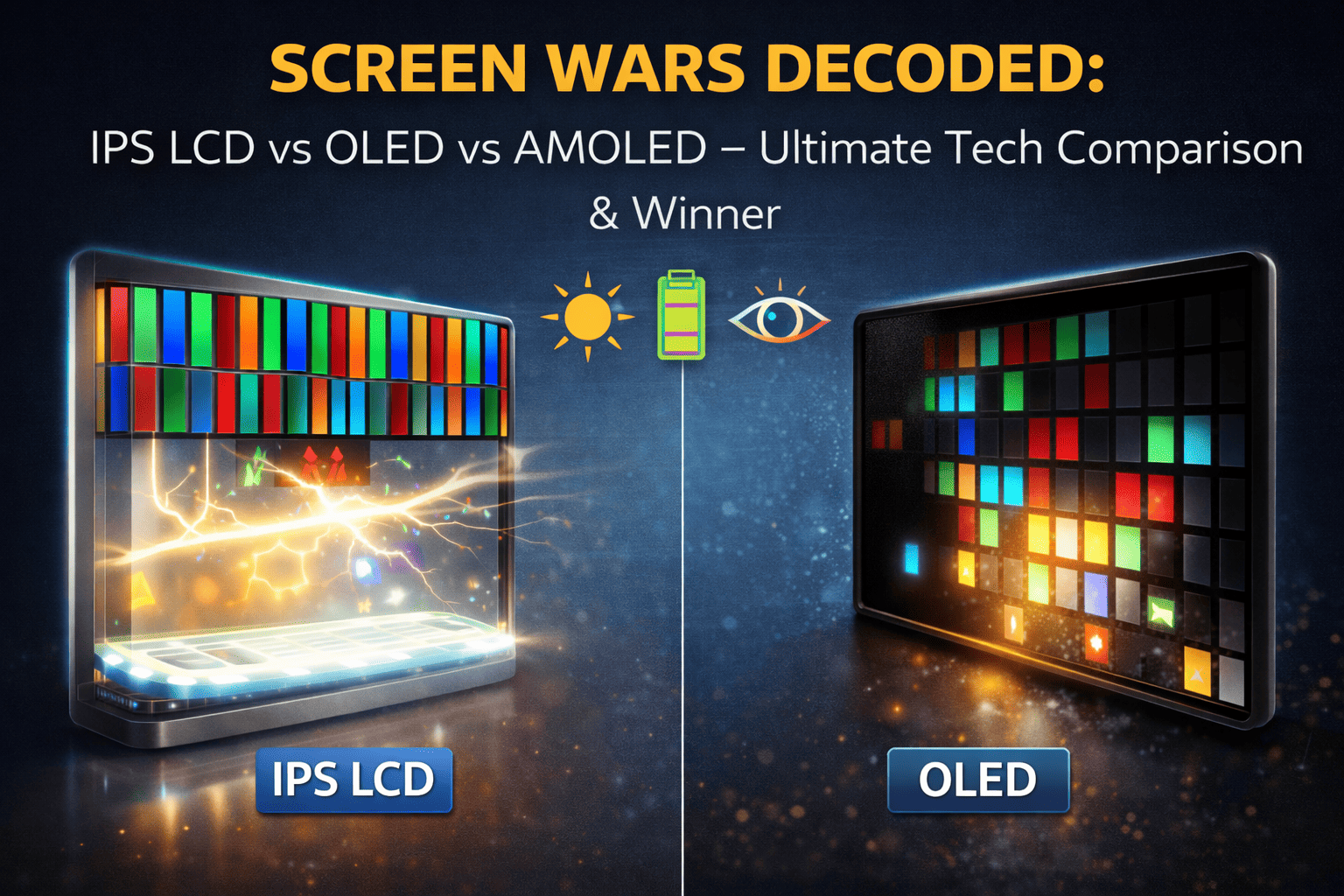
Walk into any electronics store, and you’re bombarded with alphabet soup: IPS LCD, OLED, Super AMOLED, LTPO, Retina, Dynamic AMOLED. It’s marketing jargon that often obscures more than it reveals. Yet, the display is your primary window to the digital world it defines your phone's look, feel, and battery life.
So, let's cut through the noise. What do these terms actually mean? How do they work? And in the battle for the best screen, which technology comes out on top for your needs? Here’s your no-nonsense guide to mobile display technology.
The Fundamental Divide: LCD vs. OLED
First, understand the two warring families. Every modern smartphone display falls into one of these two camps, which work on completely different principles.
1. LCD (Liquid Crystal Display) – The Veteran
How It Works: Think of an LCD as a sophisticated light filter.
1-A backlight (usually LEDs) shines white light from behind the entire panel.
2-A layer of liquid crystals acts like tiny shutters for each pixel (red, green, blue). They twist and untwist to block or allow light to pass through.
3-Color filters turn that white light into the desired color for each pixel.
The Core Limitation: Pixels cannot produce true black. To show black, the liquid crystals try to block the backlight, but some light always bleeds through, resulting in muted, grayish blacks and lower contrast. The backlight is always on.
2. OLED (Organic Light-Emitting Diode) – The Challenger
How It Works: This is an emissive technology. Each pixel is its own microscopic light source.
1-Each sub-pixel (Red, Green, Blue) is made from an organic compound that lights up when an electric current is applied.
2-To display true black, the pixel simply turns completely off. No light is emitted.
3-There is no backlight.
The Core Advantage: Infinite contrast ratio (because black is the absence of light), perfect blacks, and potentially thinner, more flexible panels.
Breaking Down the Sub-Types & Marketing Names
Under the LCD Umbrella:
TFT LCD: The basic, older type. Slower response, poorer viewing angles. Rare in phones today.
IPS LCD (In-Plane Switching): The gold standard for LCDs in mid-to-high-end phones. Liquid crystals switch in a plane parallel to the panel, giving it excellent color accuracy and wide viewing angles. It's reliable and cost-effective. Example: Many iPhones until the iPhone 12, many mid-range Android phones.
Retina (Apple), Liquid Retina, etc.: These are not technologies. They are Apple marketing terms for high-resolution IPS LCD (and now OLED) displays where pixels are "indistinguishable" at a normal viewing distance.
Under the OLED Umbrella:
OLED (Generic): The base technology. Used by LG and others. Often has a separate touch layer.
AMOLED (Active-Matrix OLED): The standard for smartphones. An active matrix of TFTs (thin-film transistors) controls each pixel, allowing for faster response and more efficient control. Almost all phone OLEDs are AMOLED.
Super AMOLED (Samsung): Samsung's marketing term for integrating the touch-sensitive layer directly into the display, removing a separate layer. This makes the panel thinner, brighter, less reflective, and more power-efficient than standard AMOLED. It's become synonymous with top-tier Samsung displays.
Dynamic AMOLED, LTPO AMOLED: Advanced versions. Dynamic adds support for HDR10+ and reduces blue light. LTPO (Low-Temperature Polycrystalline Oxide) is a backplane technology that allows the refresh rate to dynamically scale from as low as 1Hz to 120Hz, saving massive power when static content is on screen. This is the current pinnacle for efficiency and is found in premium iPhones (ProMotion) and Samsung Galaxy S/Ultra models.
The Head-to-Head Comparison: Which is "Superior"?
The answer depends on your priorities. Here’s a breakdown:
| Feature | IPS LCD | OLED/AMOLED | Winner & Why |
| Black Levels & Contrast | Grayish blacks, finite contrast. | True, perfect blacks, infinite contrast. | OLED. This is its killer feature, essential for HDR content and deep, immersive visuals. |
| Power Efficiency | Consumes consistent power (backlight always on). Power use is tied to brightness. | Pixel-dependent. Black pixels use zero power. Dark mode, mostly black screens save significant battery. Bright white screens can use more power than LCD. | OLED (for typical use). With dark modes and dark UI themes, OLED is generally more efficient for the average user. |
| Color Vibrancy | Very good, often more color-accurate (especially for professional work). | Extremely vibrant, can be oversaturated (a feature, not a bug, for most consumers). Samsung's are famously punchy. | Tie / Preference. OLED wins for "pop," calibrated IPS LCD wins for "accuracy." |
| Brightness (Peak) | Historically better in direct sunlight. | Modern Super AMOLED panels (with high peak brightness ~2000+ nits) now match or exceed LCD. | Modern Tie. Latest OLEDs are incredibly bright. |
| Screen Burn-In Risk | Virtually none. | A potential long-term risk. Static UI elements (status bars, navigation buttons) can cause permanent, faint ghost images if left at high brightness for 1000s of hours. Modern panels have software mitigations (pixel shifting). | IPS LCD. Burn-in is OLED's Achilles' heel, though much improved. |
| Cost & Longevity | Cheaper to manufacture. No organic material degradation. | More expensive. Organic compounds degrade very slowly over time, potentially leading to slight color shift after years. | IPS LCD. More affordable and longer inherent material lifespan. |
| Flexibility | Rigid. | Can be made flexible, enabling curved edges and foldable phones. | OLED. This is why all foldables use OLED. |
The Verdict: Who Should Choose What?
Choose OLED/AMOLED if: You want the best possible media consumption experience (movies, games), love deep blacks and vibrant colors, use dark mode religiously, and want a modern flagship experience with high refresh rates. You accept a minor long-term burn-in risk.
you can check out used mobiles that have best in class screen. click here
Choose a good IPS LCD if: Your priority is value-for-money, you need absolute color accuracy for photo editing, you keep phones for 5+ years and worry about burn-in, or you are buying a budget to mid-range device where a good LCD is better than a cheap, poor-quality OLED.
The State of Play in 2024/2025:
OLED is the undisputed king of the high-end smartphone market. Its advantages in contrast, form factor (thin, flexible), and efficiency with modern software (dark mode) are decisive. Super AMOLED and LTPO variants represent the current peak. However, excellent IPS LCDs remain incredibly relevant in the budget and mid-range segments, where they deliver great performance without the OLED premium.
In the screen wars, OLED won the battle for the soul of the premium smartphone. But the best display for you is the one that balances the specs you crave with the price you're willing to pay.

Comments
Please login to post a comment
LoginNo comments yet. Be the first to comment!