From Rotary Dials to Real-Time Reality: The Astonishing Journey of the Mobile Phone

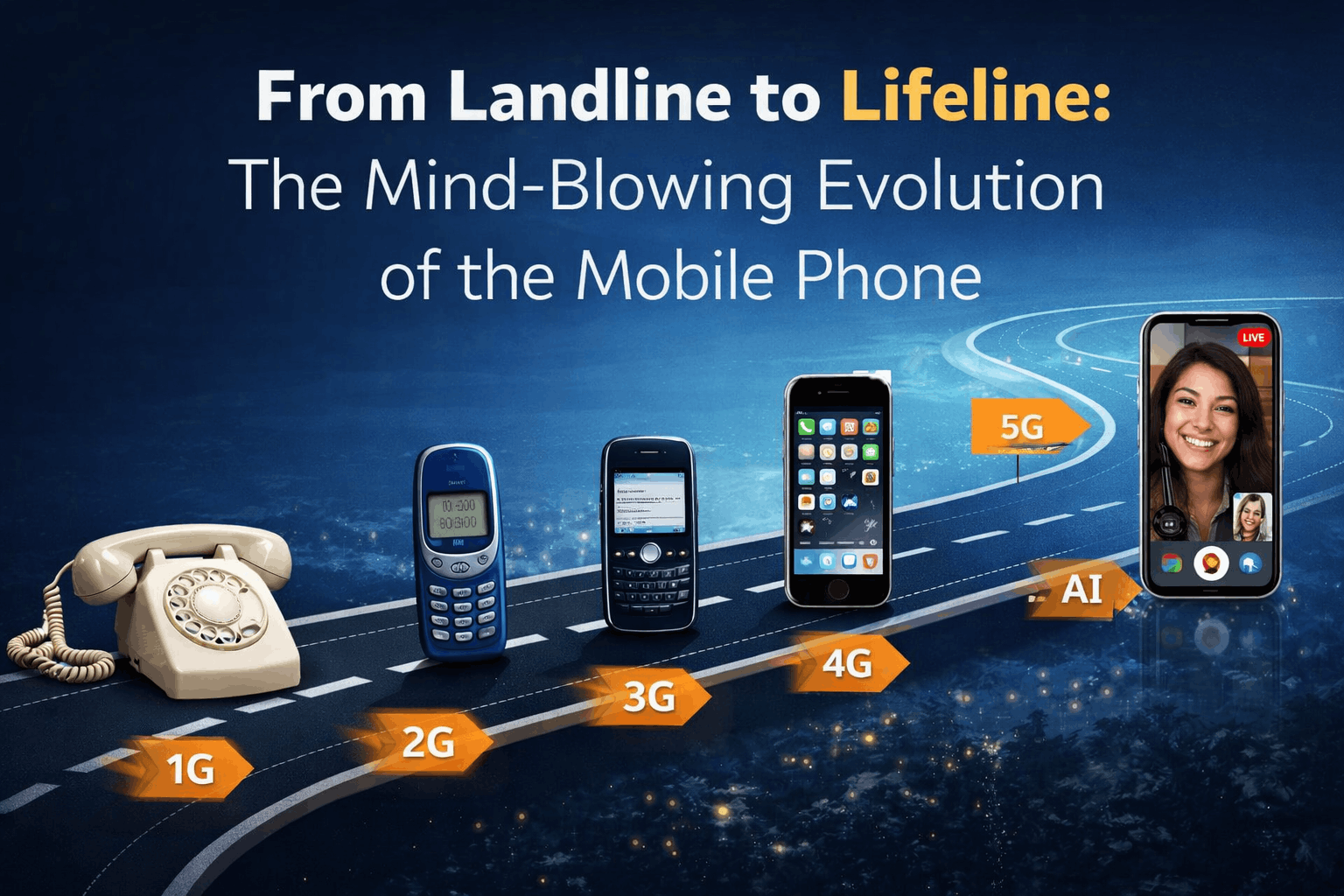
The device in your pocket is a miracle so commonplace we forget to be amazed. It’s a portal to all human knowledge, a global broadcasting studio, a wallet, a map, and a window to another person’s face all without a single wire. But this reality is the result of a breathtakingly fast technological revolution. Let’s trace the journey from a landline shackled to a wall to the wireless supercomputer that connects us with a tap.
Part 1: The Tethered World – The Reign of the Landline
For nearly a century, communication was a place, not a person. You called a location a home, an office and hoped the right person was there.
- The Rotary Phone (1900s-1970s): A heavy, mechanical marvel. Each number dialed required spinning a wheel and waiting for it to click back, a process that felt eternal. It was shared family property, often in a central hallway, with no privacy.
- The Corded & Cordless Phone (1980s-1990s): Push buttons replaced the rotary dial. The cordless phone was the first taste of freedom, allowing you to wander maybe 100 feet from the base station, often with a hissy, staticky connection. But you were still calling a place.
The limitation was the copper wire. It was a physical tether defining the very concept of a call.
Part 2: The First Great Leap: Cutting the Cord (The 1G & 2G Era)
The mobile phone didn't start smart; it started as a mobile version of the landline.
- The "Brick Phone" (1980s - 1G): The Motorola DynaTAC 8000X (1983) was the first commercial cellular phone. It cost $4,000, offered 30 minutes of talk time after 10 hours of charging, and was used almost exclusively by Wall Street traders and fictional drug lords. It was about voice, and that alone was revolutionary.
- The Era of the Flip Phone (1990s - 2G): With digital networks (GSM, CDMA), phones shrank. The Nokia 3310 became iconic. Batteries lasted a week. SMS texting was born a side-channel feature that would change language forever. This was the dawn of personal, portable communication, but the internet was a slow, painful WAP browser glimpse.
Part 3: The Smartphone Revolution: The Computer in Your Pocket (The 3G & 4G Era)
although they are getting harmful for human too, you can checkout this blog too : Blue Light, Brain Lock: How Mobile Screens Hijack Your Sleep, The Definitive Science-Backed Guide
This was the paradigm shift. Phones stopped being just phones and became platforms.
- The Pioneers (2000s - 3G): BlackBerry mastered mobile email. Palm Pilots and Windows PDAs added calendars and notes. But they were for "productivity."
- The Big Bang: iPhone & Android (2007 onward - 3G/4G): The iPhone introduced the multi-touch screen as the interface, an app store, and a real web browser. It made the internet personal and portable. Android followed, democratizing the smartphone. 4G LTE was the critical enabler high-speed mobile broadband. Now you could stream music, watch YouTube, and download apps in seconds. The phone was now your camera, your GPS, your gaming console.
Part 4: The Magic Trick: Seeing Each Other in Real Time (The Video Call)
The video call is the ultimate convergence of several evolutions:
- Fast Networks (4G/5G): It requires massive, sustained two-way data flow for audio and video. 3G couldn't handle it reliably; 4G made it standard; 5G makes it flawless.
- Advanced Cameras: Front-facing cameras evolved from grainy VGA sensors to high-resolution, wide-angle lenses with computational photography.
- Processing Power: Modern chips (like the A-series or Snapdragon) encode and decode high-definition video streams in real time while running the app.
- Software & Compression: Algorithms like H.265 compress video data massively without visible quality loss, and services like FaceTime, Zoom, and Google Meet manage the complex networking to sync audio and video streams across the globe.
The landline gave you a voice in a room. The smartphone puts a person in your hand.
Part 5: The Present & The Blurring Future: How Fast Are We Going?
The pace is not linear; it's exponential. We are now in the era of contextual and ambient computing.
- 5G & The IoT Dream: Beyond faster phones, 5G promises the Internet of Things (IoT) connecting everything from your fridge to your car in real-time with ultra-low latency.
- AI On-Device: Your phone's chip now has a Neural Processing Unit (NPU). AI isn't in the cloud; it's in your hand, powering real-time language translation in calls, magical photo editing, and predictive text that feels like mind-reading.
- The Foldable & Form Factor Experiment: After 15 years of glass slabs, we're seeing phones fold into tablets, hinting at a future where the device adapts to the task.
- The Next Interface Shift (AR/VR): Cameras and sensors are turning your phone into a window for Augmented Reality (AR). The next step may be moving beyond the screen entirely to glasses or wearables, making the "phone" as we know it invisible.
Conclusion: The Most Rapidly Adopted Technology in History
It took about 70 years for landlines to saturate households. The smartphone achieved global dominance in less than 15 years. We've gone from calling a place, to texting a person, to sharing a live video moment with someone on the other side of the planet all in the span of a single generation.
The trajectory points to a future where the technology disappears into the fabric of our lives. We won't "make a video call"; we'll simply share a moment of presence, with the technology mediating so seamlessly we forget it's there. From a rotary dial stuck on a wall to that, in just over 100 years, is not just progress. It’s one of the most profound and rapid transformations in human history, and it's resting in your pocket right now.

Comments
Please login to post a comment
LoginNo comments yet. Be the first to comment!