How Your Phone's Night-time Brightness is Sabotaging Your Eyes & Health⎮The Midnight Sun in Your Hands
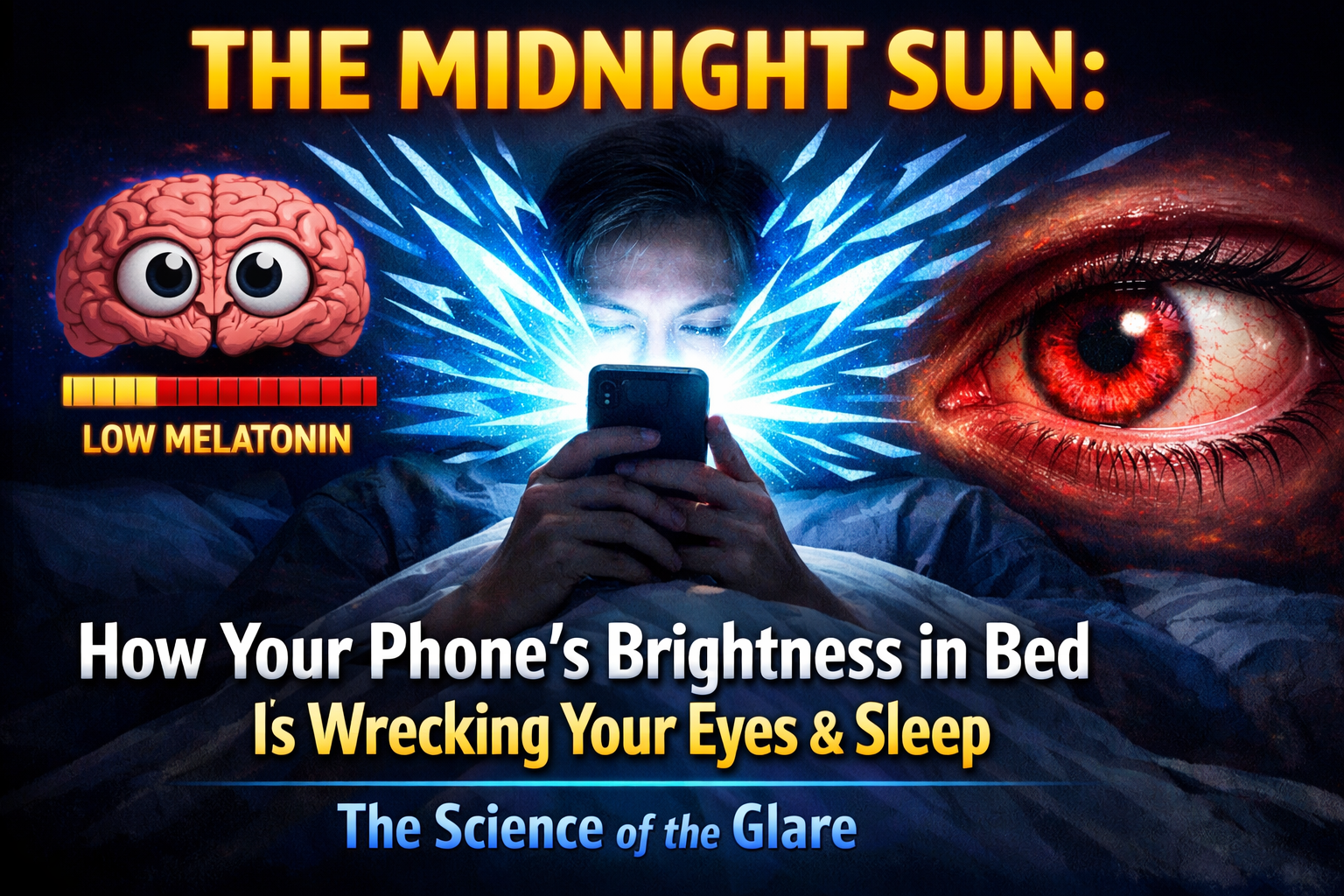
It's a universal modern ritual. The lights are off, you're in bed, and the cool, bright glow of your phone screen is the only thing illuminating the room. You've probably heard it's "bad for you," but dismissed it as an old wives' tale. The truth, however, is grounded in disruptive biology. Using your phone at high brightness in a dark room isn't just a bad habit it's a direct assault on your eyes, your sleep architecture, and your long term health.
Let's move beyond the vague warnings and examine the specific, evidence based mechanisms of harm.
1. The Immediate Assault: Digital Eye Strain & Accommodative Spasm
Your eyes are not built for this extreme contrast. In a dark room, your pupils are dilated to let in as much light as possible. Suddenly, you shove a tiny, blazing sun (your phone at 80-100% brightness) inches from your face.
The Glare Bomb: This causes immediate photostress. The intense point source light creates glare and scattering within the eye, leading to:
Eyestrain and Headaches: The muscles around your eyes (ciliary muscles) work overtime to constantly focus and adjust between the bright screen and the dark surroundings.
Dry, Irritated Eyes: Studies show we blink 66% less frequently when staring at digital screens. In a dry bedroom environment, this leads to rapid tear film evaporation, causing that gritty, tired feeling. A study in The Ocular Surface journal directly links prolonged screen use to destabilization of the tear film.
The "Fake Nearsightedness" Effect: This intense near focus can trigger a temporary accommodative spasm. Your eye's lens gets "stuck" in a short focus mode. When you finally look away into the dark, your vision may be briefly blurry for distance a phenomenon sometimes called "transient smartphone myopia."
2. The Hormonal Hijacking: Melatonin Suppression & Sleep Sabotage
This is the most well documented and serious consequence. Your body's sleep wake cycle (circadian rhythm) is governed by light exposure.
The Melanopsin Problem: Specialized cells in your retina contain a photopigment called melanopsin, which is exceptionally sensitive to short wavelength "blue" light. Your phone's LED screen, especially at high brightness, emits a massive spike of this blue light.
The Chemical Cancellation: When melanopsin detects this light particularly in the darkness when it expects none it sends a direct signal to your brain's pineal gland: "Stop producing melatonin." Melatonin is not just a sleepiness hormone; it's the chemical conductor of your body's nightly repair mode.
The Research is Clear: A landmark study in the journal Sleep found that participants using light emitting e-readers before bed had significantly reduced melatonin levels, took longer to fall asleep, and had reduced REM sleep compared to those reading a printed book. They also reported being more tired the next morning. High brightness amplifies this effect exponentially.
3. The Long Term Shadows: Potential Links to Macular Degeneration
While the direct causal chain is still being researched, leading ophthalmologists voice serious concern about cumulative, lifelong exposure.
The Theory: High-energy blue light penetrates all the way to the retina, the light sensitive layer at the back of your eye. Laboratory studies have shown that prolonged exposure to high intensity blue light can damage retinal cells (photoreceptors) and contribute to oxidative stress.
The Worry: This damage is a known pathway for Age related Macular Degeneration (AMD), the leading cause of permanent vision loss in adults. By bathing our retinas in intense blue light during their most vulnerable (dark adapted) state, we may be accelerating this process. The American Macular Degeneration Foundation lists "exposure to bright sunlight or blue light" as a potential risk factor.
4. The Mental Health Ripple: Beyond the Eyes
Poor sleep architecture doesn't just make you groggy. Chronic sleep disruption from nighttime screen use is linked by the Journal of Clinical Sleep Medicine and others to:
Increased anxiety and irritability.
Impaired cognitive function and memory consolidation.
Weakened immune response.
Dysregulation of hunger hormones, linked to weight gain.
Your Evidence Based Nighttime Survival Guide
You don't have to choose between scrolling and health. You need smarter settings.
1. The #1 Rule: Dramatically Reduce Brightness. Manually lower it to the absolute minimum level you can comfortably read at. Your screen should be the dimmest thing in the room, not the brightest.
2. Enable Night Shift / Blue Light Filter (But Know Its Limits): This warms the screen color to amber, reducing blue light emission. However, a 2020 University of Manchester study in Current Biology suggested that screen brightness (luminance) might be more disruptive to circadian rhythms than color temperature. Use it, but don't let it give you a false sense of security still lower the brightness.
3. Embrace "Dark Mode" or "Bedtime Mode": This flips interfaces to black backgrounds with white text, drastically reducing overall light emission, especially on OLED screens where black pixels are truly off.
4. The 20-20-20 Rule: Every 20 minutes, look at something 20 feet away for at least 20 seconds. This breaks the accommodative spasm and prompts blinking.
5. The 30 Minute Digital Curfew: Stop all screen use at least 30 minutes before you intend to sleep. Let melatonin rise naturally. Read a physical book or listen to an audiobook instead.
6. Consider Physical Defense: For the truly sensitive, amber tinted "blue blocking" glasses can filter the wavelength at the source, though their efficacy for sleep is debated. More reliably, keep your phone at an arm's length to reduce intensity.
The Bottom Line
Your phone on high brightness in a dark room is a biological mismatch. It confuses your eyes, cancels your sleep hormones, and may be slowly stressing the most delicate tissues of your vision.
Think of it this way: you wouldn't turn on a stadium floodlight in your bedroom to read. Your phone at full brightness is the digital equivalent. Treat the tool with respect for your own biology. Your eyes and your restful sleep are worth the tap it takes to dim the screen.

Comments
Please login to post a comment
LoginNo comments yet. Be the first to comment!