Sony Xperia 1 VIII Review: The Anti-Flagship That Refuses to Die

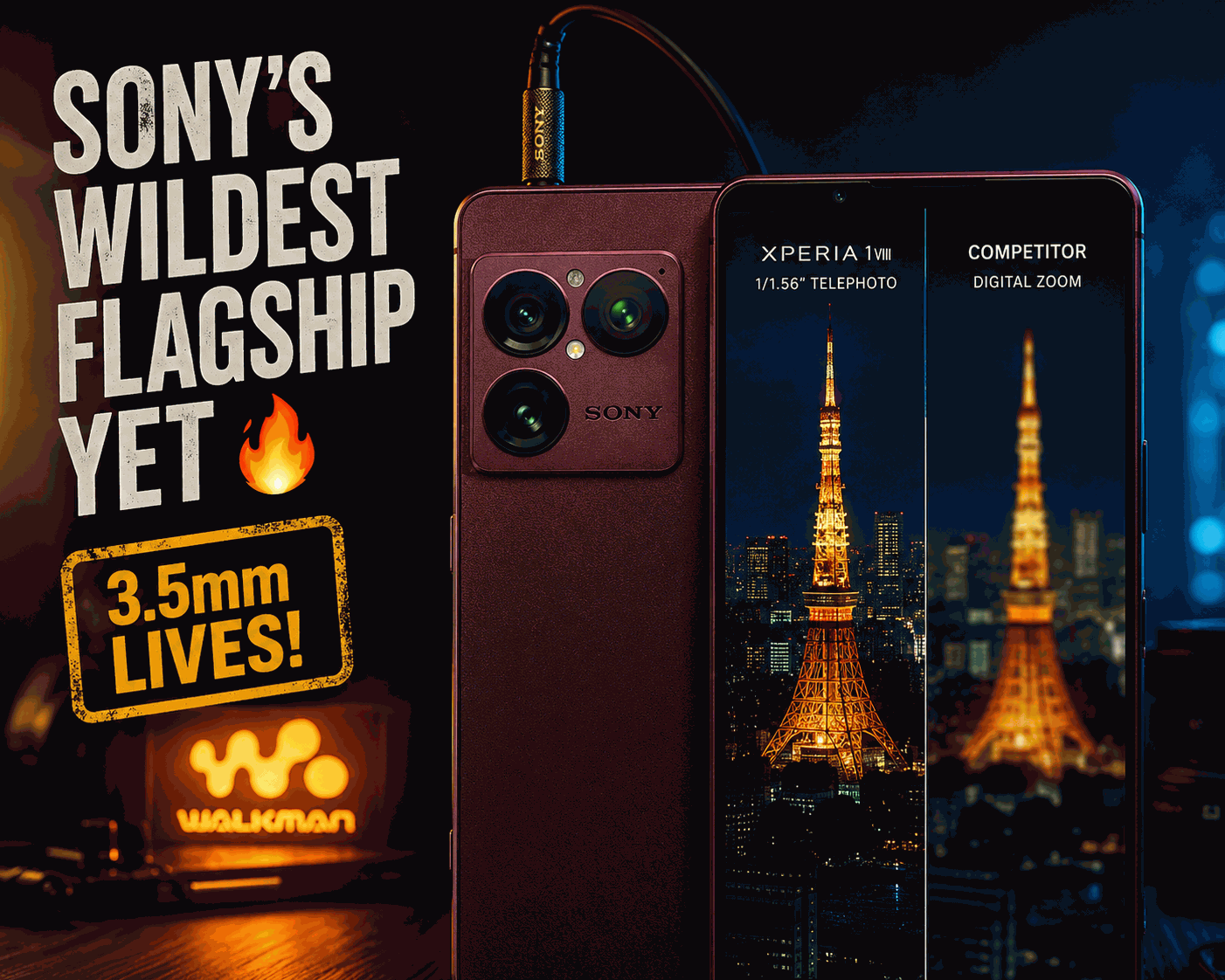
Sony has just dropped the Xperia 1 VIII, and honestly, it’s the most "Sony" phone in years. Big camera sensors, a 3.5mm headphone jack, and a design that actually dares to be different. Here’s my take after digging through every spec sheet and review.
Remember when phones had headphone jacks? Remember when you could plug in your $300 wired IEMs without needing a dongle that you'd inevitably lose in your couch cushions? Sony remembers.
In a world where Samsung and Apple are busy removing features, Sony just doubled down on everything we thought was dead. The Xperia 1 VIII is here, and it's got a 3.5mm audio jack, a microSD card slot, and a camera design that looks like nothing else on the market. It's also €1,499—more expensive than Samsung's Galaxy S26 Ultra in some markets.
Is it worth it? Let's break it down.
The Camera: Sony Finally Listened
Let's start with the elephant in the room. Sony spent years pushing a continuous optical zoom lens on the Xperia 1 series. It sounded amazing on paper—a smooth zoom from 85mm to 170mm! No other phone did it! But the problem was the sensor. It was tiny. A 1/3.5-inch sensor, to be exact. That's barely bigger than a grain of rice.
And in low light? Forget about it. Zoom shots looked like watercolor paintings.
So for the Xperia 1 VIII, Sony did something drastic. They killed the zoom lens. Gone. Dead. In its place? A fixed 70mm telephoto lens (roughly 2.9x optical zoom) with a massive 1/1.56-inch 48MP sensor.
Sony claims this new sensor is roughly four times larger than last year's telephoto sensor. And that's not marketing fluff—the numbers check out. The old sensor was about 12mm². The new one? 50mm². That's a massive jump.
What does this mean for actual photos?
Better low-light zoom shots. Sharper details at night. More natural background blur (bokeh) without needing portrait mode to fake it. And because it's a 48MP sensor, you can crop in for effectively 140mm zoom without losing too much quality. It's not a replacement for a proper periscope lens, but for most people, it's more than enough.
The main camera (24mm, 1/1.35-inch 48MP sensor) and ultrawide (16mm, 1/1.56-inch 48MP sensor) carry over from last year. But there's a new trick up Sony's sleeve: RAW multi-frame processing now applies to all three rear cameras. That means better HDR, less noise, and more dynamic range across the board.
And then there's the AI Camera Assistant.
This is Sony's answer to Google's Pixel camera smarts. When you point the camera at a subject, it analyzes the scene—the weather, the lighting, the subject itself—and makes real-time suggestions. Maybe it recommends switching to the telephoto lens. Maybe it suggests a warmer color tone. Maybe it offers a specific bokeh effect. You can tap to apply it or ignore it completely.
It's optional. It's not intrusive. And for someone who just wants a great photo without digging through Pro mode menus, it's genuinely helpful.
The Big Trade-Off: No More Optical Zoom
I have to be honest here. Losing the continuous optical zoom hurts for a specific type of user. If you're someone who regularly shoots at 85mm, 100mm, 120mm, and beyond, you're going to miss that flexibility.
But here's the counter-argument: how often were you actually using those in-between focal lengths? And when you did, how often were the photos actually good?
The old 85-170mm zoom lens had a tiny sensor and mediocre image quality in anything less than perfect lighting. The new 70mm fixed lens has a giant sensor and excellent quality in almost any condition. For 95% of users, that's a win.
You can still zoom further using digital crop from the 48MP sensor. And Sony claims the AI processing helps maintain quality at higher zoom levels. But it's not optical zoom, and you will notice a difference.
It's a trade-off. For low-light zoom enthusiasts, it's a good trade-off. For bird watchers and sports photographers, it's a step back.
The Design: Ore, Stones, and Textures
Let's talk about how this phone looks and feels, because Sony actually changed something this year.
For the past seven years, the Xperia 1 series had a vertical camera strip running down the left side of the back. It was distinctive, but it was also starting to feel dated. The Xperia 1 VIII ditches that entirely in favor of a new square camera island called "ORE."
Sony says the design is inspired by raw gemstones and natural textures. And honestly? It works. The camera module is square with slightly rounded corners, and the glass back has a fine, matte texture that feels grippy—almost like a very smooth stone. It's not slippery like every other glass sandwich phone on the market.
The phone comes in four colors: Graphite Black (safe), Iolite Silver (classy), Garnet Red (bold), and Native Gold (exclusive to Sony's online store).
The dimensions are 162 x 74 x 8.3mm, weighing exactly 200 grams. It's slightly thicker than the Xperia 1 VII, likely to accommodate the larger camera sensors and the bigger battery.
And yes, the top and bottom bezels are still there. Sony stubbornly refuses to adopt a punch-hole camera. Instead, the 12MP selfie camera lives in the top bezel alongside the front-firing stereo speakers. It looks old-fashioned. It also means you get a completely uninterrupted display with no notches or holes. For video watchers and gamers, that's a blessing.
The Headphone Jack: Long Live the King
I need to dedicate a whole section to this because it's genuinely remarkable in 2026.
The Xperia 1 VIII has a 3.5mm headphone jack.
Sony kept the headphone jack alive through the XZ3, the Xperia 1, the Xperia 1 II, III, IV, V, VI, VII, and now VIII. While Samsung killed the jack in 2019 and Google followed suit in 2020, Sony has stubbornly refused to budge. Every FCC filing, every leak, every rumor—the jack is always there.
This isn't just a headphone jack. It's a statement.
Sony's audio team tuned it using expertise from their Walkman division. It supports high-resolution audio and delivers clean, powerful output that easily drives demanding headphones. Paired with the dual front-firing stereo speakers—now perfectly balanced for deeper bass and wider soundstage—the Xperia 1 VIII is arguably the best audio phone you can buy today.
It's for the people who still have a drawer full of wired headphones. The people who refuse to buy Bluetooth earbuds because of battery degradation. The people who actually care about audio quality.
Sony is making this phone for you.
Performance and Battery: The Good and The Not-So-Good
Under the hood, the Xperia 1 VIII runs on Qualcomm's Snapdragon 8 Elite Gen 5 chipset, paired with 12GB or 16GB of RAM and up to 1TB of storage (plus microSD expansion).
Geekbench scores suggest the phone is hitting around 2,325 in single-core and 9,217 in multi-core tests. That's solid, but not class-leading. Some early reports suggest thermal throttling might be an issue during sustained heavy use, but we'll need to wait for retail units to confirm.
Gaming performance is strong. The Adreno 840 GPU handles anything you throw at it, and the 120Hz LTPO OLED display keeps everything smooth. Just don't expect to run Genshin Impact at max settings for hours without the phone warming up.
The battery is a 5,000mAh cell—exactly the same as last year. In 2026, when Chinese flagships are pushing 6,000mAh and even 7,000mAh, this feels a bit behind. Sony claims the phone can last two days on a single charge, and early tests from GSMArena suggest it's getting around 17 hours and 47 minutes of active use. That's actually better than the Samsung Galaxy S26 Ultra, despite the smaller battery.
But here's the problem: charging.
The Xperia 1 VIII supports only 30W wired charging and 15W wireless charging. That's painfully slow in 2026. Rival phones are hitting 80W, 100W, even 120W. The Xperia 1 VIII takes about 83 minutes to go from 0 to 100%.
Sony will tell you it's about preserving long-term battery health. They claim the battery maintains 80% capacity for up to four years. That's admirable. But for power users who need to top up quickly between shoots or while traveling, this is a genuine inconvenience.
The Display and Software: Old School, But Not In A Bad Way
The display is a 6.5-inch LTPO OLED panel with a 19.5:9 aspect ratio, 1080 x 2340 resolution, and a 1-120Hz variable refresh rate.
Is Full HD+ enough for a 6.5-inch screen? For most people, yes. The pixel density is around 396 ppi, which is perfectly sharp at normal viewing distances. But if you're used to Quad HD displays on Samsung flagships, you might notice slightly less crisp text.
The bezels are thick, but they house the front-facing stereo speakers and the selfie camera. And those speakers? They're genuinely good. Sony tuned them to be perfectly balanced, with deep bass and clear highs. Watching movies on this phone is a pleasure.
On the software side, the Xperia 1 VIII ships with Android 16 and Sony's clean, near-stock interface. There's very little bloatware, no duplicate apps, and no aggressive RAM management. It's one of the purest Android experiences you can get outside of a Pixel.
Sony has also committed to four major Android updates and six years of security patches. That's a huge improvement from their old update policy and puts them on par with Samsung and Google.
Price and Availability: Bring Your Wallet
Let's talk numbers.
The Sony Xperia 1 VIII starts at €1,499 / £1,399 for the 12GB/256GB model. The high-end 16GB/1TB version costs €1,999 / £1,849.
In Hong Kong, prices are HKD 12,099 for 12GB/256GB and HKD 15,899 for 16GB/1TB.
For comparison, the Samsung Galaxy S26 Ultra starts at around 1,300.TheiPhone17ProMaxisroughly1,300.TheiPhone17ProMaxisroughly1,200. Sony is charging a premium for a phone that lacks optical zoom, slow-charging, and older display tech.
That said, pre-orders in Europe come with a free pair of Sony WH-1000XM6 headphones (value around €400), which softens the blow considerably.
Here's the bad news: Sony has no plans to bring the Xperia 1 VIII to the US. American fans will have to import from Europe or Asia, which adds additional cost and hassle.
Who Is This Phone For?
The Sony Xperia 1 VIII is not for everyone. It's not for the person who wants the best value. It's not for the person who wants the fastest charging. It's not even for the person who wants the best zoom range.
This phone is for the enthusiast.
It's for the person who still has wired headphones. The person who shoots in manual mode at family gatherings. The person who wants a microSD card slot because 256GB is never enough. The person who remembers when phones had personality.
It's for the Sony fan who was worried the company would follow the industry into bland, featureless slabs.
Final Verdict
The Xperia 1 VIII is the best Sony phone in years. The camera upgrades are meaningful, the design refresh is welcome, and the stubborn retention of features like the headphone jack and microSD slot makes it a genuine alternative to the homogeneous flagships from Samsung and Apple.
But it's not perfect. The charging speeds are embarrassing for a 2026 flagship. The lack of US availability is frustrating. And the price is hard to swallow, even with the free headphones.
If you're in Europe, if you care about photography and audio, and if you're willing to pay a premium for a phone that refuses to follow the crowd—pre-order the Xperia 1 VIII.
If you just want the best value for money? Look elsewhere.
Sony doesn't make phones for everyone. And honestly? That's why I respect them.
That's my take. What about you? Still clinging to your wired headphones? Hit the comments and let me know. 👇

Comments
Please login to post a comment
LoginNo comments yet. Be the first to comment!