1G to 5G Decoded: The Technical Evolution That Transformed Humanity

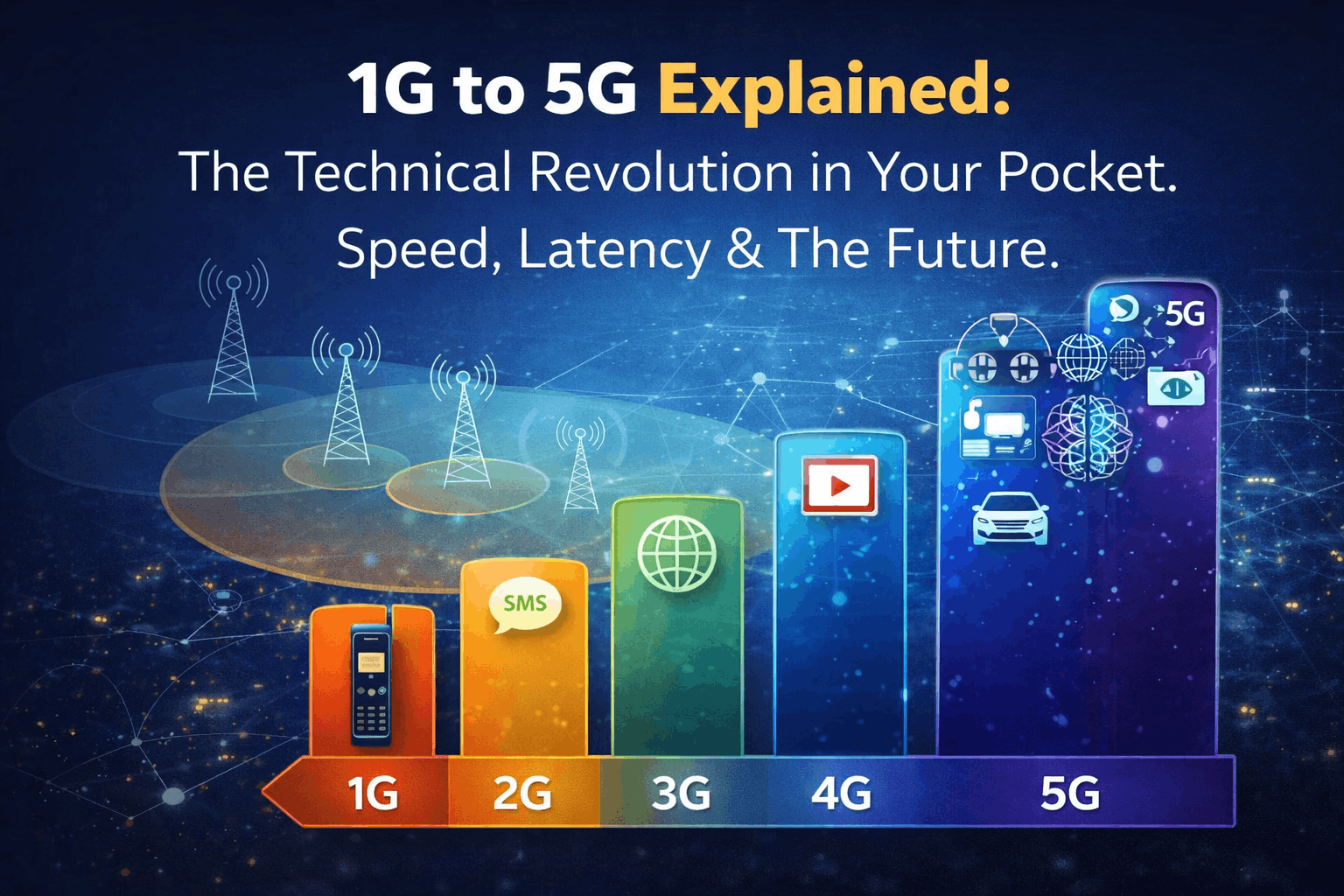
Every time you make a video call, stream a movie in a moving car, or download an app in seconds, you’re riding on an invisible highway of radio waves that has undergone a radical transformation. The "G" in 4G or 5G stands for "Generation," and each represents a fundamental revolution in how mobile networks are built, how they encode data, and what they enable us to do. This is not just about "faster internet." It's a story of shifting from analog voice to digital intelligence, re-engineering the very airwaves to connect our world.
Let's break down the technical DNA of each generation and the seismic shift it created.
The Foundational Concept: How Mobile Networks Work (The Short Version)
At its core, every "G" is a system of cell towers that divide geography into "cells." Your phone is a two-way radio that connects to the tower in its cell. Each generation improves how this connection is managed, how many devices it can handle, how data is packed into signals, and how cells interact.
1G (1980s): The Analog Voice Pioneer
-
Technology: Analog Frequency Modulation (FM), similar to a radio station. Your voice was converted into an analog radio signal on a specific frequency.
-
How It Worked: A circuit-switched network dedicated one entire frequency channel to a single call for its entire duration.
-
Improvement: It introduced mobile telephony, cutting the cord. You could now make a call from a car.
-
Fatal Flaws: No security. Anyone with a radio scanner could eavesdrop. Poor voice quality, static, no data services, and extremely inefficient use of the radio spectrum. It was a proof of concept that screamed for a digital successor.
-
Key Standard: Advanced Mobile Phone System (AMPS).
2G (1990s): The Digital Revolution & The Birth of Data
-
Technology: Digital Signal Processing. Your voice was converted into binary code (1s and 0s) before transmission.
-
Key Innovation 1: Time Division Multiple Access (TDMA - GSM standard) and Code Division Multiple Access (CDMA). These were revolutionary multiplexing techniques. Instead of one call per frequency, they sliced the digital signal into tiny time slots (TDMA) or used unique codes (CDMA), allowing multiple users to share the same frequency efficiently.
-
Key Innovation 2: SMS (Short Message Service). A side-channel for sending tiny packets of text data, born from unused signaling capacity in the GSM standard.
-
Improvement: Massive leap in capacity, security (encryption), and battery life. Digital signals were cleaner and required less power. Enabled basic data services (GPRS: "2.5G") for WAP browsing and email at dial-up speeds (~40 kbps).
-
Key Standard: Global System for Mobile Communications (GSM).
3G (2000s): The Mobile Internet Dawn
-
Goal: Provide "true" mobile broadband for web browsing, email, and basic video.
-
Technology: Wideband CDMA (W-CDMA). Used a wider radio channel (5 MHz vs. 200 kHz for 2G) to carry more data.
-
How It Worked: Continued with packet-switched networks (more efficient than 2G's circuit-switched core for data) and introduced advanced modulation to pack more bits per radio wave cycle.
-
Improvement: Made the "mobile internet" a practical reality. Speeds from 0.2 Mbps to 2 Mbps enabled the first viable video calls, GPS navigation, and app stores. The iPhone, launched on 2G, truly flourished with 3G.
-
Key Standard: Universal Mobile Telecommunications System (UMTS).
since you look like a tech knowledge seeker, you may also find it interesting: What 12nm, 6nm, 3nm Really Means for Your Phone's Brain, The Shrinking Universe in Your Pocket
4G LTE (2010s): The Smartphone Fuel
-
Technology: All-IP Packet-Switched Network. Everything even voice calls (VoLTE) became data packets flowing over the internet. The core breakthrough was Orthogonal Frequency Division Multiple Access (OFDMA) for the downlink.
-
OFDMA Explained (The Magic): Unlike channelizing for users (like 3G), OFDMA breaks data into thousands of small, closely spaced, orthogonal (non-interfering) sub-carriers. It dynamically assigns different groups of these sub-carriers to different users simultaneously, based on their signal quality and demand. This is like a highway with thousands of tiny, adaptable lanes instead of a few fixed truck lanes.
-
Improvement: True broadband in your pocket. Peak speeds of 100 Mbps to 1 Gbps. This enabled HD video streaming, mobile gaming, instant app downloads, and the seamless cloud-based ecosystem we live in today. It made the modern smartphone experience possible.
-
Key Standard: Long-Term Evolution (LTE). *True 4G as per ITU standards is called "LTE-Advanced."*
5G (2020s): The Network for Society, Not Just Phones
5G is not one upgrade; it's three revolutionary technologies woven into one network, defined by the ITU's IMT-2020 standards.
-
Enhanced Mobile Broadband (eMBB):
-
Technology: Uses higher frequency spectrum, including millimeter wave (mmWave) bands (24-100 GHz). These bands offer massive channel widths (hundreds of MHz) for incredible speeds (multi-Gbps), but have short range and poor penetration.
-
Improvement: Enables 4K/8K streaming, VR/AR, and fiber-like wireless speeds.
-
-
Ultra-Reliable Low Latency Communications (URLLC):
-
Technology: Network slicing (creating virtual, dedicated sub-networks) and a re-designed air interface with mini-slots for faster transmission.
-
Improvement: Reduces latency (network delay) to 1 millisecond. Critical for remote surgery, autonomous vehicle coordination, and industrial robotics where a delay is catastrophic.
-
-
Massive Machine-Type Communications (mMTC):
-
Technology: Designed to connect a vast density of devices (up to 1 million per sq. km) with minimal power consumption.
-
Improvement: The backbone of the Internet of Things (IoT), enabling smart cities, connected sensors, and wearables that last for years on a battery.
-
How 5G Works Together: It uses a heterogeneous network (HetNet): mmWave small cells for dense urban speed, mid-band for coverage and capacity, and low-band for wide-area coverage, all managed by intelligent software.
and if you want to buy 4g, 5g used mobiles, you can check our used mobile section.
The Cumulative Impact: From Talking to Transforming
| Generation | Core Innovation | Max Speed | Latency | What It Enabled |
|---|---|---|---|---|
| 1G | Analog Voice | N/A | High | Mobile calls |
| 2G | Digital, TDMA/CDMA | 40 kbps | ~600 ms | SMS, basic data |
| 3G | Wider channels, Packet Core | 2 Mbps | ~100 ms | Mobile web, video calls |
| 4G | All-IP, OFDMA | 1 Gbps | ~30 ms | HD streaming, App Economy, Cloud |
| 5G | mmWave, Network Slicing, IoT | 20 Gbps | 1 ms | AR/VR, Autonomous Systems, Smart Everything |
References & Further Reading (Authentic Sources):
-
International Telecommunication Union (ITU). (2015). IMT-2020 (5G) Promotion Group. Setting the scene for 5G: Opportunities & challenges. This is the defining global standard.
-
Andrews, J. G., Buzzi, S., Choi, W., Hanly, S. V., Lozano, A., Soong, A. C., & Zhang, J. C. (2014). What will 5G be? IEEE Journal on Selected Areas in Communications, 32(6), 1065-1082. A seminal academic paper outlining the three-pillar vision for 5G.
-
Mishra, A. R. (2007). Fundamentals of Cellular Network Planning and Optimisation: 2G/2.5G/3G... Evolution to 4G. John Wiley & Sons. (Covers the core RF engineering evolution).
-
Ghosh, A., Ratasuk, R., Mondal, B., Mangalvedhe, N., & Thomas, T. (2010). LTE-advanced: next-generation wireless broadband technology. IEEE Wireless Communications, 17(3), 10-22. (Details the OFDMA and core advances of 4G).
-
3GPP (3rd Generation Partnership Project). Official Specification Series (e.g., 21, 22, 23, 24, 25, 36, 38 series). These are the technical blueprints for 3G, 4G, and 5G, defining every protocol and procedure.
The journey from 1G to 5G is a masterclass in innovation under constraint squeezing exponentially more intelligence, speed, and reliability from the same limited radio spectrum. We’ve evolved from networks that connected people through voice to an intelligent fabric that will connect machines, intelligence, and reality itself.

Comments
Please login to post a comment
LoginNo comments yet. Be the first to comment!