How Cheap Chargers and Cables Are Murdering Your Phone
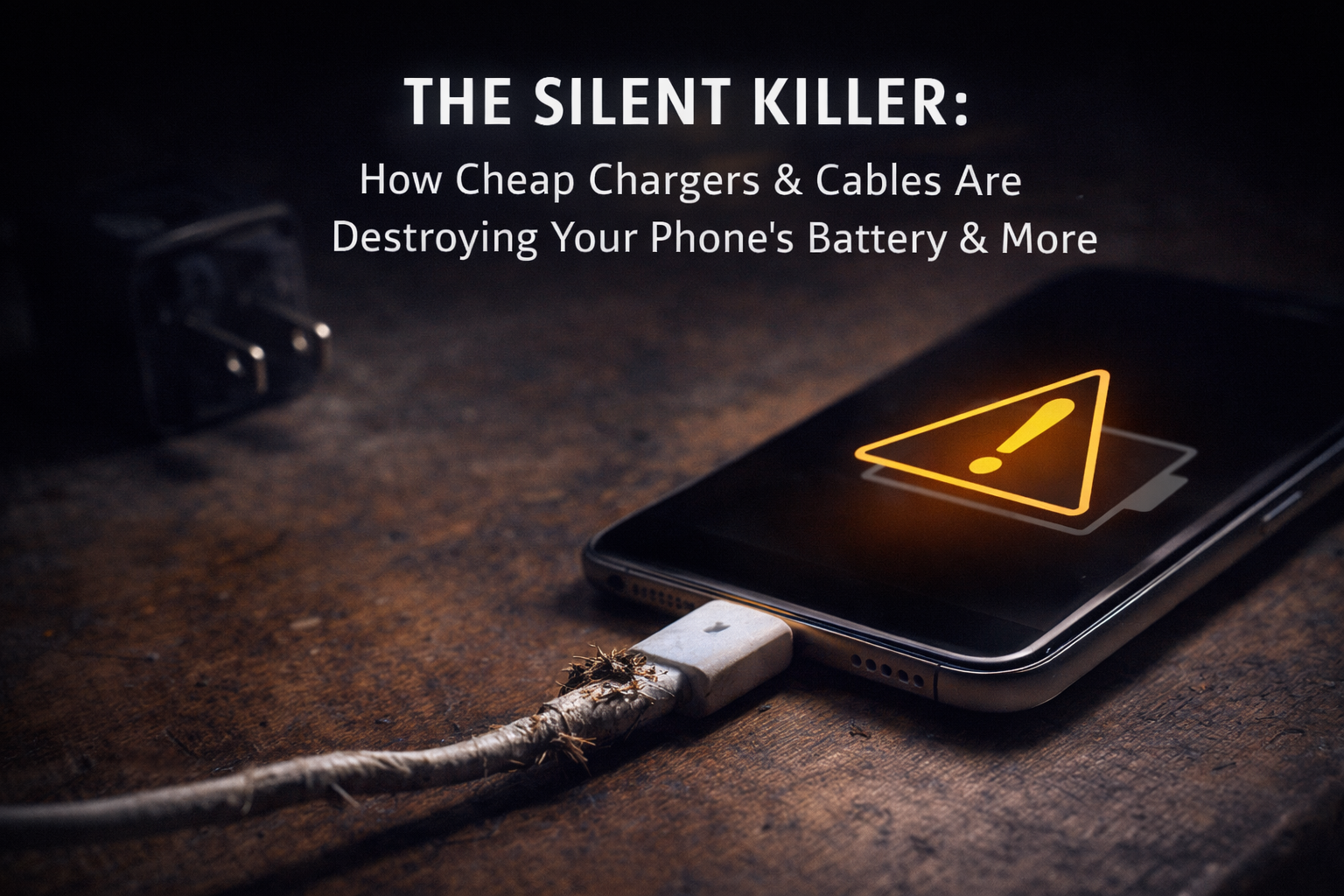
We've all done it. The official charger is upstairs, the phone is at 1%, and that sketchy, no-name cable from the gas station checkout line looks like a lifeline. You plug it in, it works, and you think, "What's the harm?"
The harm is real, insidious, and often cumulative. That $5 charger and cable aren't just slow they are an active threat to the $1,000 computer in your pocket. This isn't fear-mongering; it's electrical engineering. Let's break down exactly how counterfeit and poor-quality chargers and cables become the silent assassins of your mobile device.
Part 1: The Direct Battery Assassination - It’s Not Just "Slow Charging"
Your phone's battery is a precise, chemical system managed by a sophisticated Battery Management System (BMS). A good charger is a respectful butler. A bad charger is a bull in a china shop.
1. The Voltage Spike (The Heart Attack)
The Science: Lithium-ion batteries require a very specific voltage (usually 5V for standard charging, or 9V/12V for fast charging protocols like PD or QC). A quality charger has robust circuitry to regulate this output to a rock-steady level.
The Cheap Charger Reality: They often lack proper voltage regulation and filtering. They can deliver "dirty power" sudden voltage spikes (surges) or drops (sags). A spike sends a jolt of excessive voltage into your phone's charging circuit.
The Damage: This overwhelms the phone's internal voltage regulator. The excess current is forced into the battery, causing accelerated chemical degradation. Each spike literally burns away a tiny bit of the battery's lifespan. Think of it as revving a car engine at the redline constantly.
2. Inconsistent Current (The Torture)
The Science: Charging is a dialogue. Your phone and charger negotiate how much current (Amps) to deliver via protocols like USB Power Delivery (PD).
The Cheap Cable Reality: Poor-quality wires have higher electrical resistance. They can't deliver the consistent current flow the phone requests. The phone's BMS gets confused, constantly trying to adjust. This results in intermittent charging (the "chirping" effect where it connects/disconnects).
The Damage: This stop-start charging creates micro-cycles of heat and stress within the battery, fragmenting the solid electrolyte interphase (SEI) layer a key component for battery health. It also prevents proper full-cycle calibration, making your battery percentage wildly inaccurate.
3. The Heat Death (The Slow Cooker)
The Synergy of Failure: A poor charger with bad voltage regulation and a cheap cable with high resistance is a perfect storm. The inefficient power transfer wastes energy as HEAT. You'll feel the cable and brick get unusually warm.
The Damage: This external heat is conducted directly into your phone's most heat-sensitive component: the battery. As we've established, heat is the #1 killer of lithium-ion cells. Sustained charging heat can permanently reduce capacity by 20-30% in a matter of months.
Part 2: The Collateral Damage – What Else Gets Destroyed?
The battery is the primary victim, but the cheap charger's rampage doesn't stop there.
1. The Port Burn-Out (The Physical Corrosion)
The Issue: Flimsy cables have poorly molded connectors with subpar, thin pins. They don't seat perfectly in your phone's USB-C or Lightning port. This loose connection can cause arcing tiny electrical sparks which physically erodes the gold-plated contacts in your phone's port.
The Result: A permanently damaged port that only works with certain cables, struggles with data transfer, or worse, fails to charge altogether. A port replacement is an expensive, invasive repair.
2. The Data/Security Breach (The Hidden Danger)
The Scary Reality: Some maliciously engineered cheap cables aren't just badly made; they are purposefully made wrong. A standard USB cable has wires for power and separate wires for data.
The "Juice Jacking" Cable: A tampered cable can have its data lines covertly connected to the power lines. When plugged into a public charging port (airport, mall), it can act as a conduit, allowing a hacker's device to install malware or siphon data from your phone while it charges. A quality, charge-only cable or a trusted data blocker ("USB condom") prevents this.
3. The Death of Fast Charging & Features
Your phone's special 45W fast charging? It requires a specific electronic handshake. Cheap chargers and cables lack the proper chip to perform it. You're not just charging slowly; you're forcing your phone to default to ancient, 5W "trickle charge" protocols, which can be less efficient and generate more heat over a long period.
4. The Fire Hazard (The Worst-Case Scenario)
This is the extreme but real risk. No-name chargers often skip over-current protection, short-circuit protection, and thermal fuses to save cents. If a component fails, it can send unfiltered mains AC voltage into your phone or simply overheat until its plastic casing melts or ignites. Your phone becomes the casualty of a small electrical fire.
The Savvy User's Survival Guide: How to Spot the Good from the Bad
- Weight & Feel: A good charger has weight (from proper transformers and shielding) and uses rigid, high-quality plastics. A cheap one feels hollow and flimsy.
- Brand & Certification: Look for reputable accessory brands (Anker, Ugreen, Belkin, Spigen, Samsung, Apple) or those with clear safety certifications (UL, CE, FCC marks). Avoid anything with misspelled words or generic names ("SuperFast Charger Pro").
- The Cable Specs: For USB-C, look for "e-marked" chips (for >60W/3A support). Thicker gauge wires are better. A well-molded, solid connector that fits snugly is key.
- The Golden Rule: If the price seems too good to be true, it is. You cannot buy a safe, reliable 65W GaN fast charger for $8. The components alone cost more.
You can also watch our video where we explain about juice jacking and bad cables it by clicking here
The Bottom Line: An Ounce of Prevention
Think of your phone's charging system as its life support. You wouldn't hook a hospital patient up to a jury-rigged, untested power supply. Don't do it to your primary connection to the world.
Investing $25-$40 in a quality, name-brand charger and a couple of robust cables isn't an accessory cost; it's insurance. It protects your phone's battery health, its physical port, its data integrity, and your own safety. That gas station cable might deliver a charge today, but it's stealing from your phone's tomorrow.

Comments
Please login to post a comment
LoginNo comments yet. Be the first to comment!