The Invisible Bedfellow: Can the Phone on Your Nightstand Really Affect Your Brain?

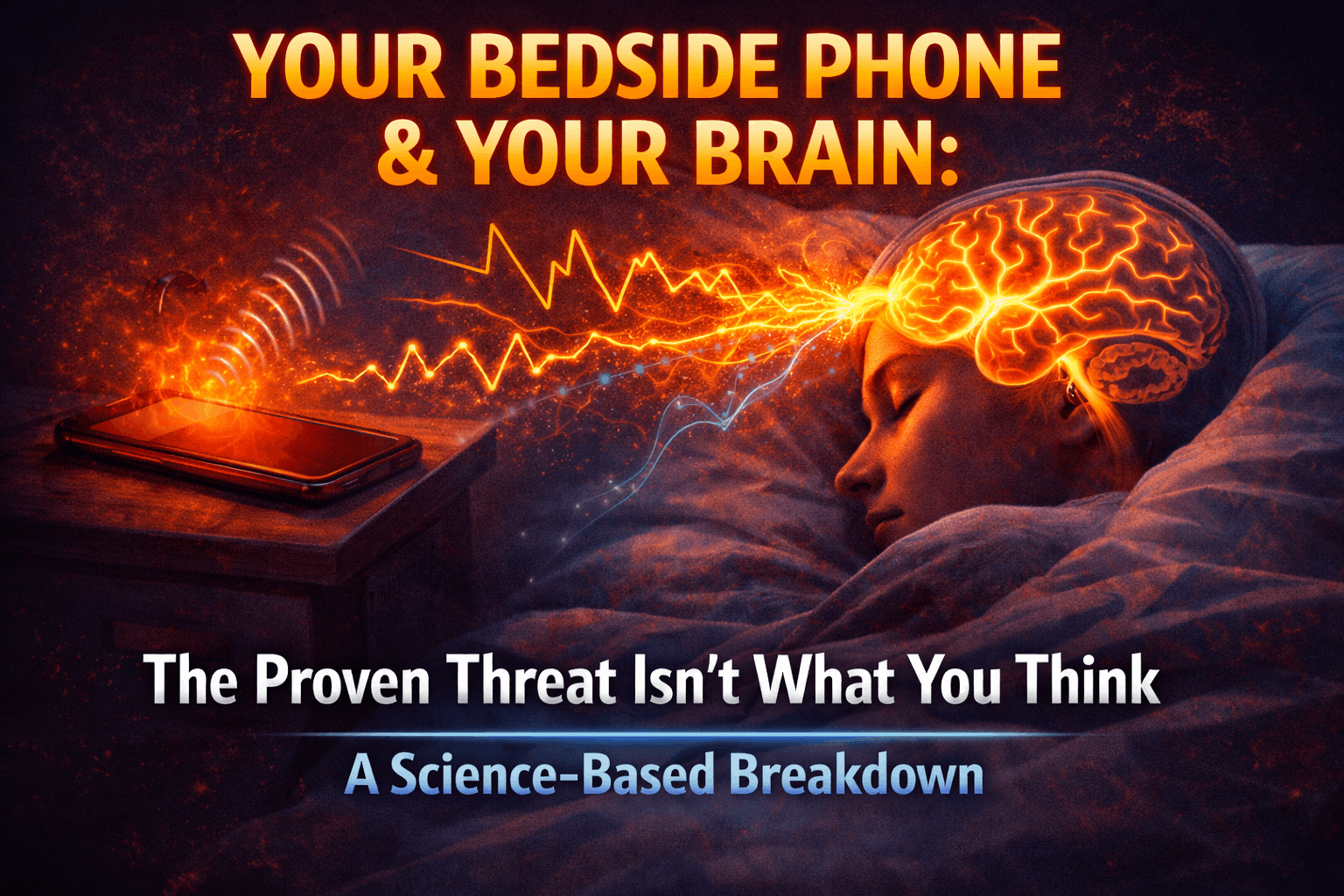
It’s the last thing we see at night and the first thing we reach for in the morning. Our smartphone has earned a permanent place on the nightstand, and for many, even migrates under the pillow. We’ve heard whispers of danger radiation, disrupted sleep, even brain health risks. But what does the science actually say? Is your bedside phone a harmless companion or a silent saboteur of your brain's well-being?
Let’s separate the evidence-based concerns from the myths and understand the real pathways of impact.
The #1 Proven Pathway: Sleep Disruption & The Cognitive Tax
This is the most direct and well-documented link between your bedside phone and your brain health. The damage isn't from mysterious rays, but from light and psychological intrusion.
- Blue Light & Melatonin Suppression: As covered previously, the blue light from your screen suppresses melatonin, the hormone critical for sleep onset and quality. Poor sleep isn't just about fatigue.
- The Brain's "Cleaning Cycle": During deep sleep, your glymphatic system activates, clearing out metabolic waste products like beta-amyloid plaques from the brain. Chronic sleep disruption hinders this process, and the accumulation of such plaques is a known biomarker for neurodegenerative diseases like Alzheimer's.
- Memory & Consolidation: Sleep is when short-term memories are transferred to long-term storage. Disrupted sleep, especially reduced REM sleep, impairs learning, memory consolidation, and cognitive performance.
- The Anxiety of Hyper-Connectivity: The mere presence of a phone within reach can induce a state of "anticipatory anxiety." Your brain remains subconsciously alert for notifications a buzz, a ping, a flash of light. This prevents the full mental disconnection required for restorative sleep, keeping your stress-response systems slightly engaged. A study in the Journal of Experimental Psychology found that just having a phone nearby, even if off, reduced cognitive capacity during demanding tasks.
The Electromagnetic Field (EMF) Question: Fear vs. Science
This is the heart of most deep-seated fears about phones and brains, especially when placed close to the head all night.
- The Type of Radiation: Smartphones emit low-frequency, non-ionizing radiofrequency (RF) radiation. This is fundamentally different from the high-frequency, ionizing radiation (like X-rays) that has enough energy to damage DNA and cause cancer.
- The Scientific Consensus: Major global health bodies, including the World Health Organization's International Agency for Research on Cancer (IARC), have classified RF radiation as "possibly carcinogenic to humans" (Group 2B). This is a hazard identification based on limited evidence, not a risk assessment. It places it in the same category as pickled vegetables and aloe vera extract, indicating a need for more research but not confirming a proven danger.
- The Precautionary Principle: While no robust, reproducible study has conclusively proven that typical cell phone RF exposure causes brain tumors or direct neuron damage in humans, the scientific community advocates for a precautionary approach due to the long latency period of cancers and the universal nature of exposure. The lack of proof is not proof of safety.
The Under-Pillow Scenario: A Perfect Storm of Risk
Placing your phone under your pillow is uniquely problematic, compounding all issues:
- Thermal Risk: Phones generate heat during operation, even in standby if fetching data. Trapping this heat under insulation (your pillow) can lead to thermal runaway, a dangerous overheating of the battery. There are documented cases of pillows and beds catching fire from this.
- Extreme Proximity: This maximizes any potential RF exposure, as the phone (which may periodically boost signal to the tower) is placed in direct, constant contact with your head for 6-8 hours.
- Sleep Disruption Guaranteed: Notifications will vibrate directly into your skull, and light will seep through, guaranteeing fragmented sleep.
The Verdict: Indirect, But Significant, Brain Health Impact
Based on current science, here’s the nuanced conclusion:
- Direct Physical Damage to Brain Cells (e.g., killing neurons via radiation)? Not proven at typical exposure levels. The prevailing scientific evidence does not support this.
- Indirect Damage to Brain Function and Long-Term Health via Sleep Destruction and Cognitive Impairment? Strongly supported and proven.
Your bedside phone's most significant threat to your brain is not frying it with waves, but starving it of the deep, uninterrupted, restorative sleep it needs to clean, repair, and consolidate itself.
Your Brain-Healthy Bedroom Protocol
- Create a Physical Barrier: The single best thing you can do is charge your phone in another room. If that’s impossible, place it at least 6-10 feet away from your bed, on a dresser or desk, face down and on Do Not Disturb.
- Enable "Airplane Mode" and "Do Not Disturb": This kills RF transmission and silences all notifications. You can often schedule this automatically for your sleep hours.
- Use a Traditional Alarm Clock: Break the dependency. A $10 battery-operated alarm clock eliminates the need for the phone to be near you at all.
- Establish a "Digital Sunset": Stop using all screens 60 minutes before bed. Let your melatonin rise naturally.
If You Must Have It Nearby: Place it on the floor beside your bed, not on your nightstand. This adds distance and reduces temptation.
Final Thought: Think of your brain's need for sleep as non-negotiable maintenance. Your phone on the nightstand is a buzzing, blinking mechanic who constantly interrupts that crucial maintenance job. The result isn't an immediate breakdown, but a gradual, cumulative wear that compromises the entire system's longevity and performance. Your brain deserves a peaceful, phone-free sanctuary.

Comments
Please login to post a comment
LoginNo comments yet. Be the first to comment!