The Megapixel Myth: Why Your 200MP Phone Camera Still Loses to a 48MP iPhone

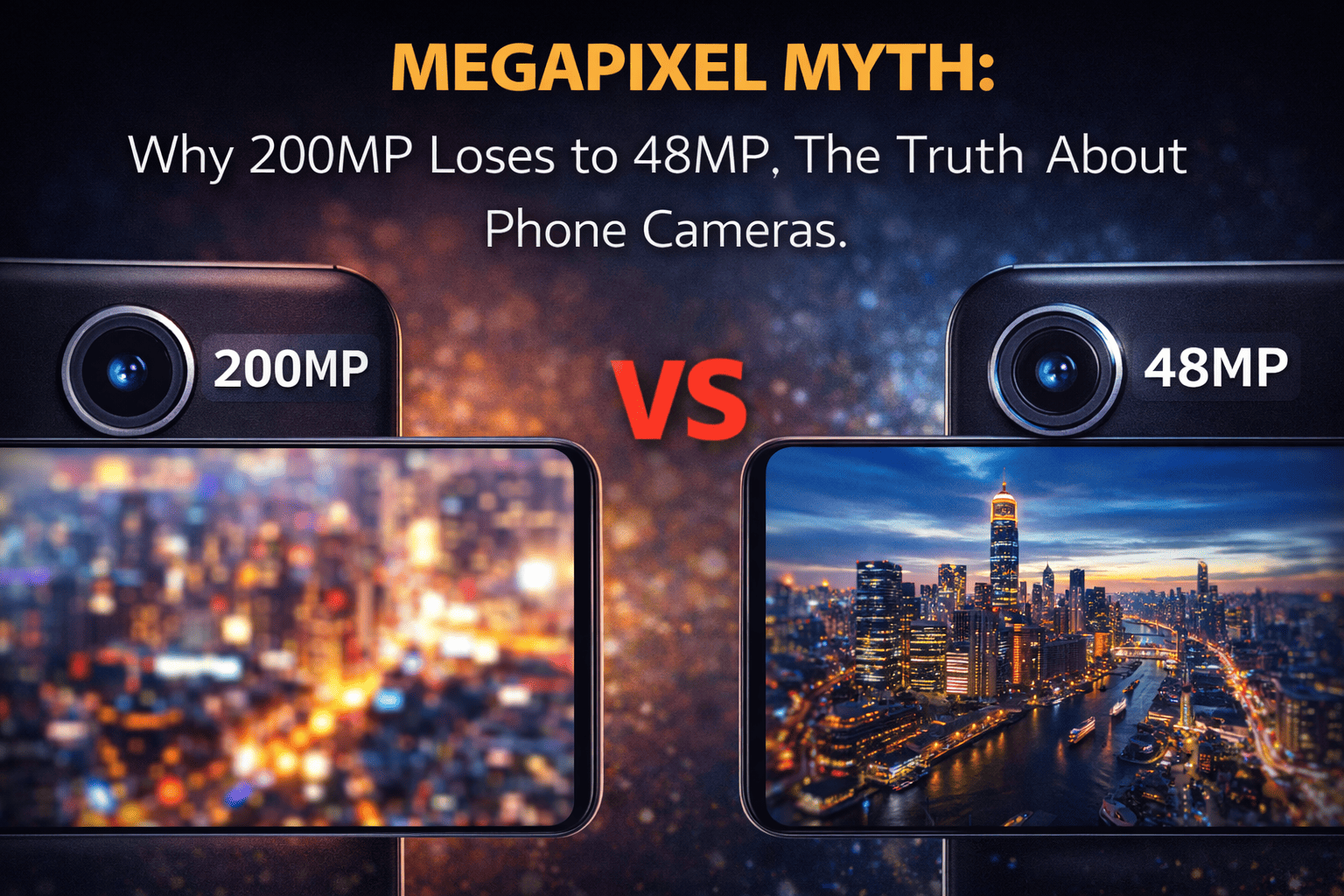
We've all been there. You're comparing phones, and one spec screams from the box: "200MP CAMERA!" The other, probably an iPhone, quietly lists a modest "48MP Main Camera." The numbers suggest a landslide victory. But pick up both phones, take a photo, and the iPhone often wins cleaner, more vibrant, more true-to-life.
This is the megapixel paradox that confuses millions of buyers. If more megapixels meant better photos, camera brands like Leica and Hasselblad would be obsolete, and every $300 Android phone with a 108MP sensor would outperform a $1,200 iPhone. They don't. So what's actually happening inside these tiny cameras? Let's shatter the megapixel myth once and for all.

Part 1: What Is a Megapixel, Actually?
Let's start with the basics. A megapixel is simply one million pixels. A 12MP camera captures 12 million individual pixels of information. A 200MP camera captures 200 million pixels. In pure resolution terms, the 200MP sensor captures 16 times more data.
But resolution is only one ingredient in the complex recipe of image quality. Think of it like painting: having a massive canvas (megapixels) doesn't make you a great artist. You need quality paint (sensor hardware), skillful brushes (lens), and artistic technique (image processing).
The Key Insight: Megapixels determine how large you can print or how much you can crop. They do not determine color accuracy, dynamic range, low-light performance, or the overall aesthetic quality of an image.

Part 2: The Physics of Light, Why Bigger Pixels Matter More
Here's the fundamental physical truth that marketing prefers to ignore: light is the raw material of photography. A camera sensor captures light through millions of tiny "buckets" called photosites. Each bucket corresponds to a pixel.
Small Pixels (High Megapixel Count): When you cram 200 million pixels onto a sensor that's physically the same size as a 48MP sensor, each individual pixel has to be tiny. Tiny pixels have a smaller surface area to catch light. They are less sensitive, especially in low-light conditions. The result? Noise, grain, and muddy colors when the sun goes down.
Large Pixels (Lower Megapixel Count): Fewer pixels on the same sized sensor means each pixel is physically larger. Larger pixels are like bigger buckets they catch more light, gather more information, and produce cleaner, brighter images with less noise.
The iPhone Philosophy: Apple consistently uses larger pixels (around 1.9µm on recent iPhones) rather than chasing megapixel counts. This prioritizes light capture over resolution, resulting in consistently excellent images across all lighting conditions.
The 200MP Reality: To fit 200 million pixels on a smartphone-sized sensor, those pixels must be microscopic (around 0.56µm). In bright daylight, they can capture impressive detail. But in anything less than perfect lighting, the tiny pixels struggle, and the image quality collapses.
Part 3: Pixel Binning, The 200MP Cheat Code
So how do 200MP phones ever produce usable photos? They use a technique called pixel binning.
How It Works:
The camera groups clusters of small pixels together to act as one larger virtual pixel. For example:
A 200MP sensor with 0.56µm pixels might use 16-to-1 pixel binning.
This combines 16 tiny pixels into one "super pixel" that acts like a larger 2.24µm pixel.
The resulting image is 12.5MP, not 200MP.
What This Means:
When you take a photo with a 200MP camera phone, you're almost never getting a true 200MP image. You're getting a binned, processed 12-50MP image that the phone's software has assembled. The 200MP number becomes largely theoretical a marketing headline rather than a practical reality.
The Catch: Pixel binning requires immense computational power and sophisticated algorithms. Not all manufacturers do this well. Poor binning algorithms can introduce artifacts, weird color processing, and soft details, defeating the purpose entirely.

Part 4: The Software Secret – Why Processing Is Everything
This is where the iPhone separates from the pack. Apple's secret weapon isn't the camera hardware it's the image signal processor (ISP) and the computational photography pipeline.
What Happens When You Press the Shutter on an iPhone:
The camera captures multiple frames at different exposures in milliseconds.
The A-series processor analyzes every pixel, identifying faces, skies, shadows, and textures.
It merges the best parts of each frame using Deep Fusion and Smart HDR.
It applies machine learning models trained on millions of professional photographs to adjust color, contrast, and noise reduction.
The final image is assembled balanced, natural, and true-to-life.
The Android Challenge:
Many Android manufacturers with 200MP sensors license camera software from third parties or use less sophisticated processing pipelines. They may capture immense resolution but fail to process it intelligently. The result is oversharpened, artificially saturated, or noisy images that look impressive zoomed out but fall apart under scrutiny.
Real-World Example:
iPhone 15 Pro (48MP): Natural skin tones, accurate white balance, excellent dynamic range, minimal noise.
Competitor 200MP Phone: Inconsistent colors, blown-out highlights in bright scenes, waxy skin texture from over-processing, and poor low-light performance.
The numbers favor the 200MP phone. The eye favors the iPhone.

Part 5: The Megapixel Hierarchy, What Actually Matters in Camera Quality
If megapixels aren't the answer, what is? Here's the real hierarchy of smartphone camera quality:
1. Sensor Size (The Most Important)
A larger physical sensor captures more light, period. This is measured in sensor "type" (1/1.28", 1/1.5", etc.). Bigger numbers after the slash mean larger sensors. The iPhone's sensor is consistently among the largest in the industry relative to its megapixel count.
2. Pixel Size (The Light Bucket)
Measured in micrometers (µm). Larger pixels (1.8µm+) outperform smaller pixels (0.6µm-0.8µm) in low light, regardless of megapixel count.
3. Lens Quality (The Gatekeeper)
A great sensor is useless behind a cheap lens. Glass quality, aperture size (f/1.5 vs f/2.4), and lens coatings all affect how much light reaches the sensor and how sharp the image is.
4. Image Signal Processor (ISP) (The Brain)
This dedicated chip processes the raw sensor data. Apple's ISP is custom-designed and deeply integrated with the A-series processor, giving it a massive advantage in speed and intelligence.
5. Computational Photography Algorithms (The Artist)
This is the software magic HDR, night mode, portrait lighting, Deep Fusion. Apple spends billions perfecting this. It's their crown jewel.
6. Megapixels (The Resolution, Finally)
At the bottom of the list. Useful for cropping and large prints, but irrelevant to overall image quality in normal use.

Part 6: Why Do Companies Push 200MP Cameras?
If megapixels aren't the key to quality, why do so many manufacturers chase them?
1. Marketing Warfare
In a crowded market, "200MP" is a number that stands out on a spec sheet. It's simple, impressive, and easily compared. "48MP" sounds smaller, even if it produces better photos. It's the same reason processor core counts exploded consumers equate "more" with "better."
2. The Cropping Advantage
There is one genuine benefit to high megapixel sensors: lossless cropping. With a 200MP image, you can zoom in digitally and still retain significant detail. This is useful for specific scenarios wildlife photography, architecture details, etc. But for everyday photography, it's rarely needed.
3. Bragging Rights
Phone makers want to win the "spec war" in reviews and comparisons. A 200MP sensor generates headlines. Whether the implementation is good or not becomes a secondary detail.
4. Future-Proofing for AI
Higher resolution images provide more data for future AI processing. As computational photography evolves, having that extra information might become more valuable. But currently, it's potential, not performance.

Part 7: The Verdict, Should You Care About Megapixels?
The Short Answer: No, not really.
The Nuanced Answer: Megapixels matter only in specific contexts and should never be the primary factor in choosing a camera phone.
there are some great phones ready to be sold check here
When Megapixels Actually Help:
You regularly print large-format photos (posters, gallery prints).
You frequently crop deeply into your images (wildlife, distant subjects).
You shoot in perfect lighting conditions and want maximum detail.
When Megapixels Don't Matter:
You share photos on social media (compressed anyway).
You take photos in mixed or low lighting (most real-world scenarios).
You want consistent, natural-looking images without editing.
The Smart Buyer's Guide:
Look at real-world samples, not spec sheets. Search for photo comparisons between phones you're considering.
Prioritize sensor size and pixel size over megapixel count.
Trust brand processing expertise. Apple, Google (Pixel), and Samsung (flagships) have spent years perfecting their computational photography.
Be skeptical of "200MP" as a primary selling point. Ask to see sample images in various lighting conditions.
based on your interest, you should also read it
The Great RAM Deception: Why Phone Companies Write "8+8" on the Box and Whether It Actually Matters
Conclusion: The Image That Matters
The megapixel myth persists because it's easy to sell numbers. It's harder to sell the subtle art of image processing, the physics of light capture, and the years of engineering that go into making a photo feel "right."
When you look at a photo from an iPhone, you're not seeing 48 million individual pixels. You're seeing the result of a holistic philosophy: capture light intelligently, process it beautifully, and deliver an image that feels true to the moment. The 200MP competitors may capture more data, but they often fail to translate that data into emotion.
In the end, photography isn't about counting pixels. It's about capturing moments. And the best camera isn't the one with the biggest number it's the one that makes you want to keep taking pictures.

Comments
Please login to post a comment
LoginNo comments yet. Be the first to comment!