Why Apple's "Late" Design Moves Are a Feature, The Tortoise and the Hare
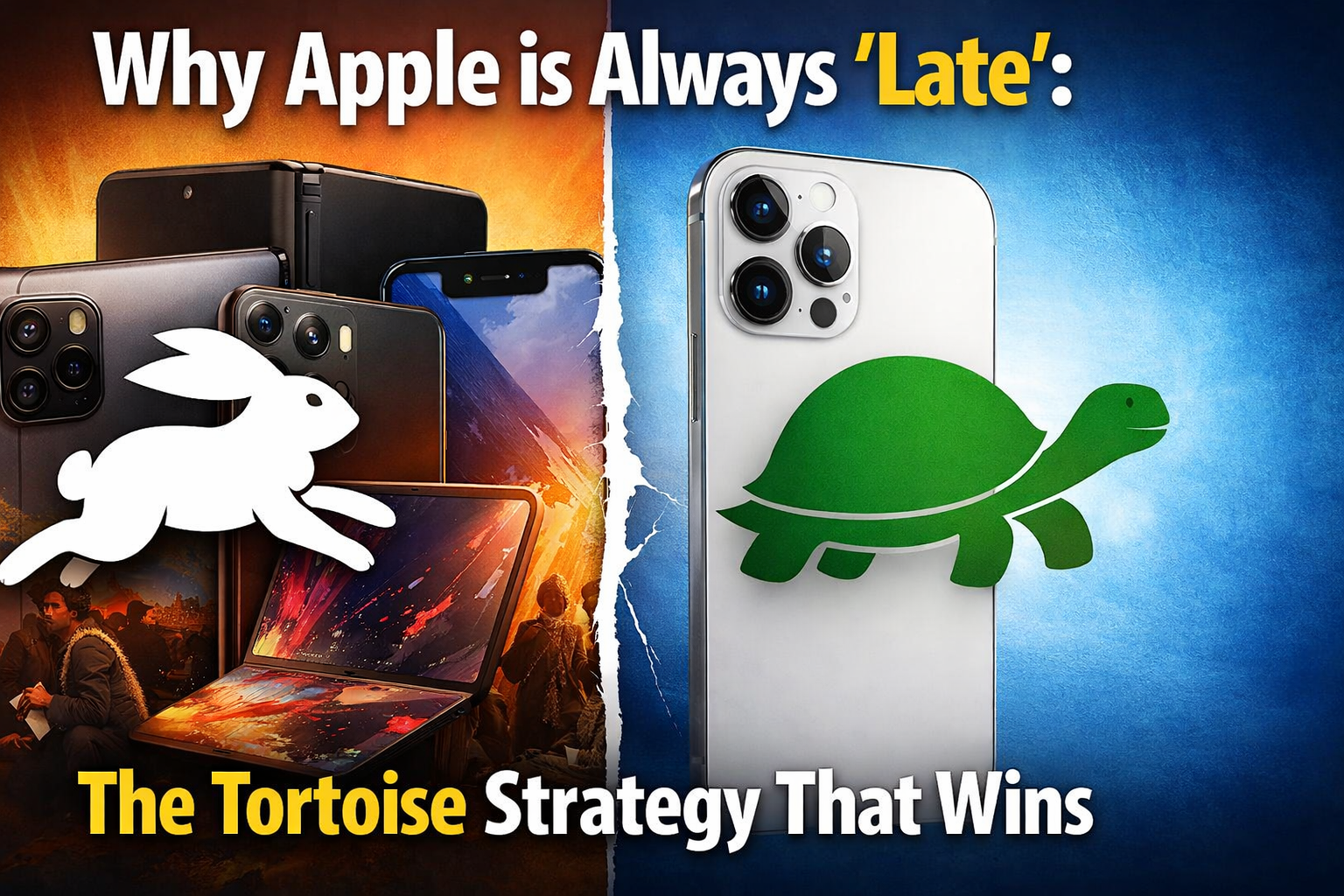
Look at any Android flagship from 2018 and you’ll see the future. Foldable screens, under-display cameras, wild charging speeds, and designs that look like they were beamed from a sci-fi movie. Then look at the iPhone. For years, it’s been a beautifully polished… rectangle. A slab of glass that seems to evolve at a glacial pace.
When Apple finally does make a big change switching to USB-C, adding a Dynamic Island, or (if the rumors are true) eventually making a foldable the collective response from the tech world is a sarcastic, "Finally! Android had that five years ago!"
It’s easy to label Apple as perpetually late, slow, or even lazy. But that’s a fundamental misreading of their strategy. Apple isn't a hare sprinting to check boxes on a spec sheet. It’s a tortoise that only moves when the path is paved, the finish line is clear, and the prize is a mainstream user experience that feels inevitable, not experimental.
Let’s crack open the logic behind the lag.
The Core Philosophy: The "Why" Before the "Wow"
Apple’s design mantra isn't "First." It’s "Does it work for everyone?" They operate on a different calculus:
The Iteration Over Invention Rule: Apple rarely invents a new form factor. They perfect an existing one. The MP3 player existed; the iPod made it simple. Smartphones existed; the iPhone made them intuitive. Tablets existed; the iPad defined the category. They let others blaze the trail, take the arrows, and discover all the painful failure points. Then, Apple walks down the now-cleared path with a refined, polished product.
The Ecosystem Lock: Every design change isn't just about the phone. It’s about Lightning cables, MagSafe accessories, app developer guidelines, service revenue, and brand loyalty. Changing a port isn't just engineering; it's disrupting a billion-dollar accessory economy and annoying hundreds of millions of users. They wait until the pain of not changing (regulatory pressure, user demand, technical limits) outweighs the pain of changing.
Case Studies: The "Late" Adopter's Playbook
USB-C (The Regulated Victory):
Android Had It: Since 2015.
Apple’s Move: 2023, on the iPhone 15.
The "Why" Now? Three reasons: 1) The EU forced their hand with legislation. 2) Their own Macs and iPads had already switched, creating internal pressure for one cable to rule them all. 3) The technical benefits (speed, universality) finally outweighed the ecosystem control and licensing revenue from Lightning. They waited until the change could be framed as a pro-consumer "unification," not a spec bump.
High Refresh Rate Displays (ProMotion):
Android Had It: Flagships since 2017.
Apple’s Move: 2021, on iPhone 13 Pro.
The "Why" Now? Battery. Early high-refresh screens were power hogs. Apple waited for LTPO technology to mature a display that can dynamically scale from 1Hz to 120Hz. This meant they could deliver the buttery smoothness without murdering battery life, a trade-off they found unacceptable for years.
Multiple Cameras & Computational Photography:
Android Had It: Dual, triple, and quad-camera arrays were mainstream by 2018.
Apple’s Move: The iPhone 11 Pro got its third lens in 2019.
The "Why" Now? Software. Apple wasn't just adding hardware; they were building the Deep Fusion and Smart HDR pipelines to merge data from all sensors seamlessly. They waited until the software could make the hardware sing in a way that felt magical and automatic, not just like a spec list.
The Foldable (The Ultimate Test):
Android Had It: Since the Galaxy Fold in 2019.
Apple’s Move: ??? (Rumored for 2025-2026 at the earliest).
The "Why" Not Yet? This is the crown jewel of their strategy. Foldables, for years, have had visible creases, fragile screens, thick hinges, and absurd prices. Apple is waiting for the technology to reach a point where a foldable iPhone doesn't feel like a compromise. It must have a crease-free screen, a reliable hinge that survives millions of folds, iPadOS-level app optimization, and a price that doesn't induce cardiac arrest. They will enter the race only when they can redefine the finish line.
The Hidden Benefits of Being "Last"
This strategy gives Apple brutal advantages:
Cost & Supply Chain Mastery: By the time Apple adopts a component (like OLED displays or 5G modems), the technology is mature and mass-produced. They get better yields, lower prices, and more reliable supply than the pioneers who paid the "early adopter tax."
User Education is Done: When Apple launches a feature, the market already understands it. The tech press has explained it for years. There's no confusion. They simply present the "Apple version," which is framed as the definitive, correct implementation.
Avoiding the Beta-Tester Label: Samsung, Google, and others use their customers as real-world R&D labs. Remember exploding batteries, folding screens breaking, or under-display cameras that looked fuzzy? Apple's brand is built on reliability. They cannot afford a high-profile hardware debacle. Waiting lets others find the landmines.
The Price of Perfection (And The Criticism)
This approach isn't without cost.
It Stifles Radical Innovation: The wait for "perfection" means we’ll never see a wild, experimental "Apple Flip" with obvious flaws but thrilling potential. The creative, iterative fun happens in the Android camp.
It Feels Arrogant: To many, it signals that Apple believes only it can do things "the right way," dismissing years of competitor progress.
It Bores Enthusiasts: For tech fans who live for the bleeding edge, Apple’s paced evolution can feel painfully dull.
The Bottom Line: Different Clocks, Different Goals
Android manufacturers are on the technology adoption clock. Their goal is to be first, to showcase the future, to win on specs.
Apple is on the mass-market adoption clock. Their goal is to be the last mover to integrate a technology only when it can be made boringly reliable, deeply integrated, and essential for everyone from a college student to a grandparent.
Calling Apple "late" is like criticizing a master chef for being the last to serve dinner. They weren't idle; they were letting the roast rest, ensuring every element on the plate was perfect. You might be hungry, but when you finally eat, you understand why they took so long.
The next time you see a flashy new feature on an Android phone, don't think, "Why doesn't Apple have this?" Think, "I wonder how many years it will take for Apple to make me forget the Android version ever existed." That’s their game. And they’re still winning it.

Comments
Please login to post a comment
LoginNo comments yet. Be the first to comment!