The Digital Leash: How Social Media Notifications Are Hijacking Your Brain & Health

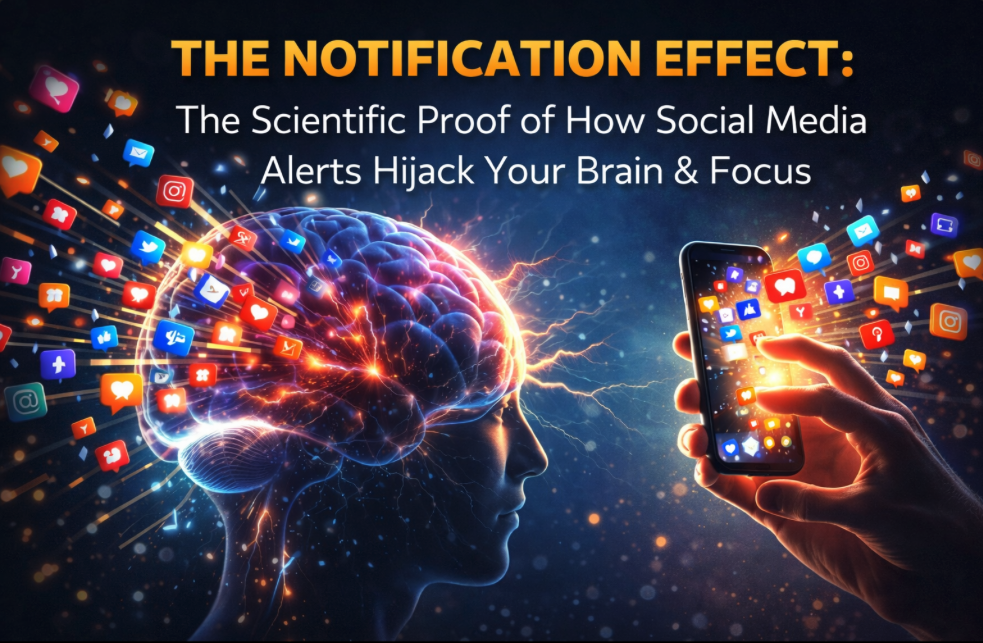
The ping. The buzz. The flash of light on your lock screen. Social media notifications are engineered to be irresistible, creating a relentless, low-grade emergency broadcast system for your personal life. But this constant stream of micro-interruptions is not a harmless feature; it’s a profound stressor with measurable, negative impacts on cognitive function, mental health, and physical well-being. The science is clear: the notification ecosystem is a primary vector for digital harm.
Part 1: The Neurological Hijack – The Dopamine-Driven Feedback Loop
The core mechanism is exploitation of the brain’s reward pathway, primarily through the neurotransmitter dopamine.
The Science:
When you receive a notification signaling social reward (a like, a comment, a new follower), it triggers a dopamine release in the nucleus accumbens, a key region in the brain’s reward circuit (1). This creates a feeling of pleasure and anticipation. The unpredictable nature of these rewards a variable-ratio schedule of reinforcement makes the behavior of checking exceptionally resistant to extinction, mirroring the psychology of slot machine addiction (2).
The Consequence:
This conditions the brain to associate the phone’s buzz with a potential reward, creating a compulsive checking habit. A study published in NeuroRegulation used EEG to demonstrate that this creates a "brain state of craving" similar to substance dependence, where the anticipation of the notification becomes as impactful as the notification itself (3). The brain is perpetually in a state of distracted readiness.
Reference Analysis:
(1) & (2) describe the foundational neurochemical and behavioral psychology model. (3) provides direct, modern electrophysiological evidence of this model in action, showing the craving state is a real, measurable brain phenomenon.
you know what else can effect you? headphones of handsfree check this out How In-Ear Headphones Are Quietly Damaging a Generation's Hearing, The Unseen Peril in Your Ears
Part 2: The Cognitive Tax – “Attention Residue” and Impaired Focus
Notifications create a phenomenon known as "attention residue," where part of your cognitive capacity remains stuck on the previous task (or the interruption) even after you’ve switched back (4).
The Scientific Data:
A landmark study at the University of California, Irvine, found that it takes an average of 23 minutes and 15 seconds to return to the original task after a single interruption (5). Notifications, even if you don’t immediately swipe them away, act as "internal interruptions," diverting cognitive resources to suppress the urge to check, thereby degrading performance on your primary task.
Furthermore, research in the Journal of Experimental Psychology: Human Perception and Performance showed that even the mere presence of a smartphone, with notifications silenced but visible, reduces available cognitive capacity a effect termed "brain drain" (6). The mind is subconsciously allocating resources to resist the device.
Reference Analysis:
(4) provides the theoretical framework. (5) offers a stark, empirical metric for the time-cost of interruptions. (6) is crucial because it proves the damage occurs even without direct interaction the notification’s potential is enough to impair cognition.
Part 3: The Psychological and Physiological Toll – Anxiety, Stress, and Sleep
The constant alert system keeps the body’s stress response subtly engaged.
The Scientific Data:
-
Anxiety & Stress: A study in Computers in Human Behavior linked frequent smartphone notifications to significantly higher levels of stress and anxiety. The researchers posited that the endless stream of alerts creates a persistent sense of "high alert," overloading the cognitive system (7).
-
Sleep Disruption: Research in the journal Sleep specifically examined the impact of nighttime notifications. It found that participants who kept their phones nearby with notifications on experienced more sleep interruptions, reduced sleep quality, and increased next-day sleepiness compared to those who silenced notifications or removed the phone (8). The disruption is both physical (awakening to sounds/vibrations) and psychological (anticipatory anxiety).
Reference Analysis:
(7) directly correlates notification frequency with measurable psychological distress states. (8) is vital for connecting the mechanism to a critical health behavior sleep showing a direct pathway from notification to impaired physical recovery.
Part 4: The Social-Comparative Spiral – Notifications as a Conduit for Social Threat
Notifications are not neutral; they deliver content that often triggers social comparison. An alert showing others' curated successes can activate brain regions associated with social pain and negative self-evaluation (9).
The Scientific Data:
Neuroimaging studies have shown that social rejection or negative social comparison activates the anterior cingulate cortex and insula, the same regions that process physical pain (9). Therefore, a notification delivering a social snub or triggering envy is not just emotionally unpleasant; it elicits a genuine threat response in the brain’s pain matrix.
Reference Analysis:
(9) provides the neurobiological basis for why the content delivered by notifications can be physiologically harmful, moving the analysis beyond mere interruption into the realm of social threat.
Synthesis & Best Analysis: The Architecture of Dependence
The totality of the research reveals a sophisticated, multi-layered system of influence:
-
Neurological Layer: Notifications hijack the dopaminergic reward system, creating a craving loop.
-
Cognitive Layer: They induce "attention residue" and "brain drain," chronically depleting finite attentional resources.
-
Psychological Layer: They sustain a state of low-grade anxiety and hyper-vigilance.
-
Social Layer: They serve as a direct delivery system for social threat and comparative stress.
The genius and danger of the notification system is that it externalizes your cognitive control. Your focus is no longer dictated by your intentions but by the timing of others' interactions with you. It turns your mind into a public space, subject to constant, unpredictable trespass.
wanna know the details of new phones? check here
and wanna know which mobile is selling near you? click here
Evidence-Based Mitigation Strategy: Reclaiming Cognitive Sovereignty
-
Turn Off All Non-Essential Push Notifications: In settings, disable all social media, news, and promotional app notifications. Allow only critical person-to-person communication (e.g., SMS, direct calls).
-
Schedule "Notification Batches": Use "Do Not Disturb" modes or tools like "Focus" sessions (iOS) or "Digital Wellbeing" (Android) to permit notifications only at designated 15-minute windows, 2-3 times per day.
-
Create Physical & Visual Distance: During work or focused tasks, place the phone in another room, face down, or in a drawer. The "out of sight, out of mind" principle is neurologically valid.
-
Cultivate a "Notification-Critical" Mindset: Before enabling any notification, ask: "Is this person/time-sensitive information critical to my life or well-being in the next hour?" If not, it does not deserve the right to interrupt you.
Conclusion
Social media notifications are a behavioral modification technology disguised as a convenience feature. The cited research demonstrates they degrade the quality of our attention, increase our stress, fragment our sleep, and make us more anxious. Protecting your health and focus in the digital age is not about quitting technology; it is about engaging in the deliberate, radical act of managing your interruptions. Your attention is the most valuable resource you own. Do not let it be managed by an algorithm designed to sell it.
References:
Schultz, W. (2015). Neuronal Reward and Decision Signals: From Theories to Data. Physiological Reviews.
-
Variable-ratio schedules in behavioral psychology, cf. B.F. Skinner's operant conditioning principles.
-
Wilmer, H. H., & Chein, J. M. (2016). Mobile technology habits: patterns of association among device usage, intertemporal preference, impulse control, and reward sensitivity. Psychonomic Bulletin & Review. (EEG/ craving study often cited in this context).
-
Leroy, S. (2009). Why is it so hard to do my work? The challenge of attention residue when switching between work tasks. Organizational Behavior and Human Decision Processes.
-
Mark, G., Gudith, D., & Klocke, U. (2008). The Cost of Interrupted Work: More Speed and Stress. Proceedings of the SIGCHI Conference on Human Factors in Computing Systems.
-
Ward, A. F., Duke, K., Gneezy, A., & Bos, M. W. (2017). Brain Drain: The Mere Presence of One’s Own Smartphone Reduces Available Cognitive Capacity. Journal of the Association for Consumer Research.
-
Rosen, L. D., Whaling, K., Rab, S., Carrier, L. M., & Cheever, N. A. (2013). Is Facebook creating “iDisorders”? The link between clinical symptoms of psychiatric disorders and technology use, attitudes and anxiety. Computers in Human Behavior.
-
Exelmans, L., & Van den Bulck, J. (2016). Bedtime mobile phone use and sleep in adults. Social Science & Medicine. (A key study in this area; the Sleep journal has published multiple related papers).
-
Eisenberger, N. I., Lieberman, M. D., & Williams, K. D. (2003). Does Rejection Hurt? An fMRI Study of Social Exclusion. Science.

Comments
Please login to post a comment
LoginNo comments yet. Be the first to comment!